
Free Referral Service — Titusville, Florida
Water Damage In Titusville, FL
Water damage in Titusville, FL is shaped by water on every side — the Indian River Lagoon to the east, Mosquito Lagoon to the north, and a water table that never sits far below the slab. One free call connects you with an independent local pro who can typically arrive in 30–60 minutes, 24/7.
Free Call · Answered 24/7 · Local Pros Near You
Quick Answer: Do not let it sit: Titusville's housing stock makes fast action count. The city has 49,385 residents and 23,595 homes, and 45.5% of those homes were built before 1980 — the 6th highest share of the 19 Florida cities we serve, versus 34.0% statewide. Federal flood zones A and AE are mapped along both lagoons, and 55.20 inches of rain fall in a year. One free call connects you with an independent local pro who can typically arrive in 30–60 minutes.
Do I Have This Problem?
Tap every sign you see at home. This is a guide, not a diagnosis — only a pro can confirm the problem.
Titusville At A Glance
How Titusville Compares
Rankings are among the 19 Florida cities we serve. Sources: U.S. Census Bureau ACS 2024 5-year estimates; NOAA 1991–2020 Climate Normals. Method: each city is ranked 1 = highest (median year built: 1 = oldest) from data/cities.csv — see the sources list at the bottom of this page.
Two Lagoons And A High Water Table: Titusville's Water Picture
Titusville is a riverfront city twice over. The Indian River Lagoon — the long, shallow coastal lagoon running the length of Brevard County — forms its eastern edge, and Mosquito Lagoon, the lagoon and wetland system to the north, drains toward the same shoreline,
Federal flood zones A, AE and X are mapped in the city area, with the high-risk A and AE zones following the lagoon shores and low ground. Your flood zone decides whether flood insurance is required and how much surge risk your street carries. Storm surge from a hurricane passing offshore can raise the lagoon and flood riverfront streets, and a king tide — an unusually high tide that arrives without any storm — can push water onto the lowest roads. A high water table completes the picture: groundwater sits close to the surface, keeping soil under slabs saturated through the wet season.
Check your own address on the Map Service Center site (msc.fema.gov) before storm season. Homes on the city's edges with a private well or a septic system — the on-site tank and drain field used without city sewer — should have well water tested after flooding, since flood water can contaminate a well.
Warning Signs Of Water Damage In Titusville, FL
Water damage usually announces itself quietly here: a ceiling stain that grows between storms, a musty smell in a room that stays shut, or baseboards that swell and gap at the floor. By the time paint bubbles, the material behind it has often been wet for weeks.
Watch for these signals:
- Stains, bubbling paint, or drywall that gives slightly when pressed
- Swollen baseboards and floors that feel warped, cupped or springy
- A water bill that jumps, or a meter that keeps moving with every fixture off
- Warm or damp spots on tile, and grout lines that darken after rain
Act on the first sign, not the fifth. In Brevard County's warm, humid air, mold growth can start within 24-48 hours on wet material, and each extra day widens the damage.
What Usually Causes Water Damage In Titusville Homes
Age drives most of it. With 45.5% of homes built before 1980 and a median build year of 1982, much of Titusville still runs on the plumbing of the space-boom decades — including cast iron drain pipe that rusts from the inside and galvanized steel pipe whose protective coating wore away long ago. Pipe corrosion in that stock is behind many of the city's hidden leaks.
The failures take familiar forms: a burst pipe in a wall, a slab leak under the concrete slab, or pinhole leaks that mist into a wall cavity for weeks. Appliances add their share — a failed water heater, a split washing machine hose, a dishwasher that leaks at the seal. The air handler contributes too: when its condensate drain clogs, the pan overflows, and an AC condensate overflow can drip into ceilings all summer before anyone notices.
Weather is the outside cause: a roof leak opened by wind-driven rain — and, rarest but most severe, a sewage backup reversing contaminated water into tubs and floor drains.
How Pros Map Hidden Moisture Before Opening Walls
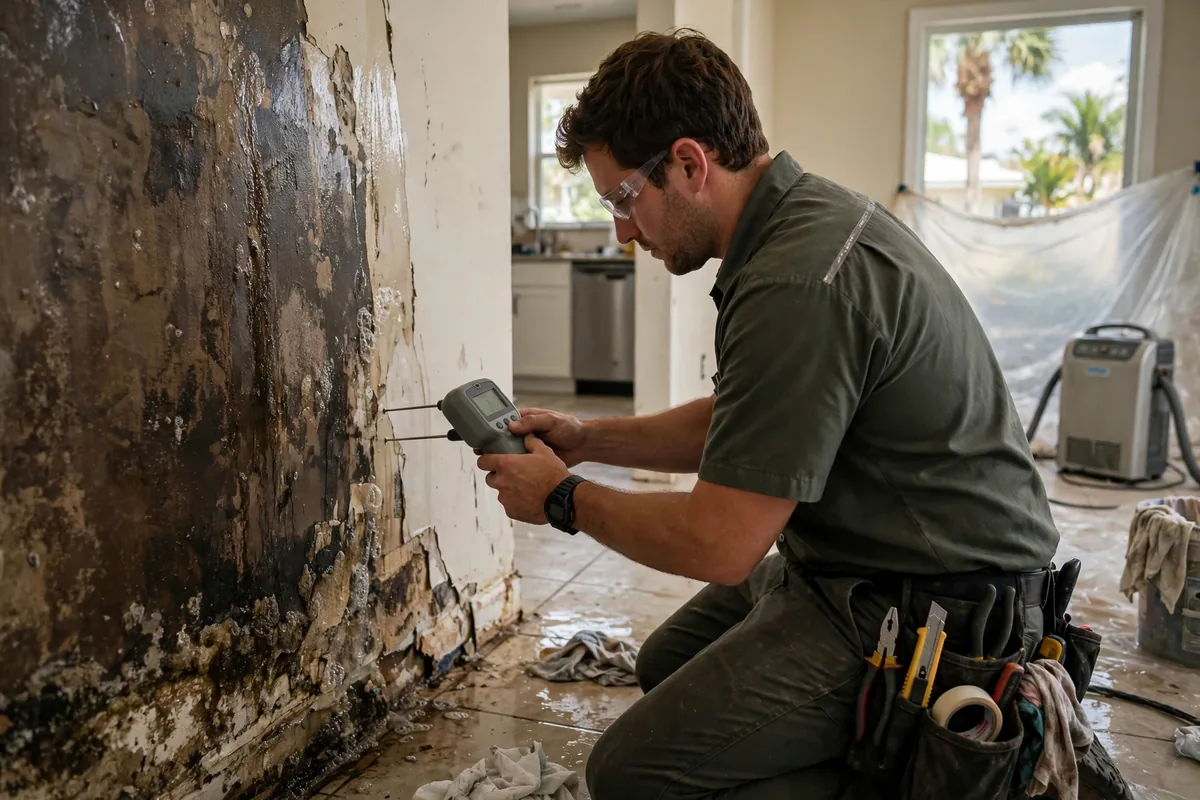
A good pro measures first and cuts last: moisture meters and moisture mapping show exactly which materials are wet, so walls are opened only where the readings demand it.
Moisture mapping means testing walls, floors and cabinetry on a grid and recording the numbers, with pin and pinless moisture meters. A thermal imaging camera backs that up — wet areas show cooler on its screen, revealing the shape of a leak behind paint or under tile. A hygrometer tracks humidity and temperature so drying can be tuned to real conditions.
Pros then return for daily monitoring, repeating the readings until every material reaches its dry standard — the moisture level of the same material in an unaffected room — rather than declaring the home dry because surfaces feel fine.
Extraction And Structural Drying, Step By Step
Step one is removal: water extraction takes standing water out with pumps and a truck-mounted extractor. Only a cleared floor can be dried.
Then structural drying begins — the planned drying of the building itself. An air mover drives air across wet floors and walls, and a dehumidifier removes the moisture from the air; an LGR dehumidifier is the commercial type that keeps performing in humid Florida conditions. Where water was contaminated, a containment barrier — sealed plastic sheeting — closes off the work area so spores and dirty air do not drift into clean rooms. Materials that cannot recover, like soaked carpet pad or crumbled drywall, are removed so framing can dry, and cleaned surfaces finish with an antimicrobial treatment.
Water Categories 1, 2 And 3 — And The Materials They Ruin
Pros grade every loss by water category, because the category sets the safety rules. Category 1 is clean water from a supply line. Category 2, or gray water, carries dirt or chemicals, like a washing machine or dishwasher discharge. Category 3, or black water, is heavily contaminated — sewage backup and lagoon flood water are always Category 3 and get the strictest handling.
What the water touched then decides what survives. Drywall soaks upward like a wick and is often cut above the wet line; insulation packed inside a wall cavity traps moisture against studs and rarely dries in place. Carpet pad holds water against the subfloor and is usually discarded. Hardwood flooring cups and buckles as it swells, though quick drying can sometimes flatten it back; laminate flooring swells at its fiberboard core and cannot be repaired. Tile and grout deceive the eye — the surface dries while water runs beneath it across the concrete slab of a slab-on-grade home, the standard Brevard build. And do not count on the weather to help: Florida humidity is so persistent that a closed, wet house barely dries at all without equipment.
Do This First When Water Gets In — And Skip The Rest
Stop the source first if you safely can: turn the main water shutoff — the valve that halts all water into the home, usually at the meter — then call. If a single appliance is the problem, its own valve may be enough.
Work safely while you wait. Keep people and pets out of standing water near outlets, appliances or the electrical panel, and shut off power to wet rooms at the breaker only from a dry place. Stay out from under a bulging or sagging ceiling. Sewage and lagoon water are contaminated — no wading and no bare-handed cleanup.
Two popular moves backfire. A household vacuum on standing or contaminated water risks electric shock, and fans aimed at dirty water just aerosolize it. Resist tearing out drywall, baseboards or flooring before photos are taken and a pro judges what can be saved; ripping out too early spreads contamination and costs claim evidence.
Paperwork That Makes A Titusville Claim Smoother
Insurers pay on documentation, so build the file before cleanup erases it: photograph and video every affected room, the water's entry point or source, tide or water lines on walls, and damaged belongings,
Then collect the pro's paperwork — the moisture logs from daily monitoring, the moisture map, and a written scope of work stating what was wet, what was dried and what was removed — and keep receipts for every related expense. One Titusville-specific point: a standard homeowners policy covers sudden failures like a burst pipe, but rising lagoon or flood water belongs to a separate flood policy through the National Flood Insurance Program (NFIP) — sorting out which event caused your damage early keeps the claim moving.
Related Services We Offer
Water Getting Worse Right Now?
Standing water, a burst pipe or sewage cannot wait. See what to do first — and call now.
Neighborhoods We Serve In Titusville
La Cita
Home to La Cita Golf and Country Club, an 18-hole course designed by Ron Garl and Lee Trevino
Arbor Ridge
A named neighborhood inside Titusville, in ZIP 32780.
Birchwood Forest
A named neighborhood inside Titusville, in ZIP 32780.
Cathedral Pines Estates
A named neighborhood inside Titusville, in ZIP 32780.
Country Club Heights
A named neighborhood inside Titusville, in ZIP 32780.
Evergreen
A named neighborhood inside Titusville, in ZIP 32780.
Fox Hollow
A named neighborhood inside Titusville, in ZIP 32780.
Fox Lake Manor
A named neighborhood inside Titusville, in ZIP 32780.
Neighborhoods we serve include:
- Arbor Ridge
- Birchwood Forest
- Cathedral Pines Estates
- Country Club Heights
- Evergreen
- Fox Hollow
- Fox Lake Manor
- Gardendale
- Harbor Pointe
- Hickory Hill
- Highlands
- Hunters Ridge
- Imperial Estates
- Indian River City
- La Cita
- Lantern Park
- Meadowridge
- Meadows South
- Rambling Acres
- Royal Oak Golf and Country Club
- San Mateo Village
- Sherwood
- Sherwood Estates
- Sisson Meadows
What Happens When You Call
You Call — It’s Free
One free call, answered 24/7. Tell us where the water is and what happened. There is no charge for the call and no obligation to book anything.
We Connect You With An Independent Local Pro
We match your call with an independent local water damage professional who serves your area — a separate local business, not our own crew.
The Pro Calls You Back Or Visits To Check The Problem
The pro can typically arrive in 30–60 minutes to check the problem in person, measure the moisture and explain the next steps before any work begins.
Why Titusville Homeowners Use This Free Referral Service
Simply put: one free call connects you with an independent local water damage pro — we make the connection, the pro does the work. There is no charge for the call, no obligation to hire, and pros can typically arrive in 30–60 minutes, day or night.
For a Space Coast homeowner watching water spread at 2 a.m., that means one explanation instead of a dozen phone calls. You describe the problem once, get matched with a pro who serves Titusville, and from there the plan, the schedule and the price are agreed directly between you and that pro.
What Homeowners Say
Reviews shown exactly as given to us (name, city, words) — we do not edit them.
“Refrig line punctured and leaked unnoticed behind our cabinets for days. They carefully pulled out the lower trim, dried out the cavity, and saved our cabinetry.”
Amber K. · Melbourne, FL
“Very professional operation. They worked directly with my homeowner insurance adjuster, providing moisture logs and thermal photos that sped up payment.”
Timothy G. · Palm Bay, FL
“A clogged HVAC condensation drain flooded our ceiling and hallway. They dried the attic insulation and hallway walls before any mold could form.”
Kimberly F. · Sanford, FL
ZIP Codes We Serve In Titusville
Titusville ZIP codes we serve: 32780, 32796. If your ZIP is not listed, call and we will confirm coverage.
Titusville Water Damage Questions
Related Guides
Is Your Well Water Safe After Flooding?
Guide — well water safety after flooding
King Tides And Tidal Flooding In Florida
Guide — what are king tides
Groundwater Seeping Up Through Your Slab
Guide — groundwater seeping through slab
Reviewed By Hamza
Role: CEO
Hamza is the CEO of this business. He is very expert in local business and has great experience.
Updated October 23, 2026
Sources
Water In Your Home Right Now?
One free call connects you with an independent local pro who can typically arrive in 30–60 minutes.
Free Call · Answered 24/7 · Local Pros Near You