
Free Referral Service — Fort Pierce, Florida
Water Damage In Fort Pierce, FL
Water damage in Fort Pierce, FL arrives from two directions — 55.89 inches of rain a year, and the Indian River Lagoon pushing in during storms and king tides. One free call connects you with an independent local pro who can typically arrive in 30–60 minutes, 24/7.
Free Call · Answered 24/7 · Local Pros Near You
Quick Answer: Start today, because Fort Pierce water rarely stays put. The city has 49,082 residents and 22,871 homes, 44.0% of them built before 1980 — the 7th highest share of the 19 Florida cities we serve, versus 34.0% statewide. Flood zones A, AE, AH, VE and X are all mapped here, including the high-risk VE coastal zone. One free call connects you with an independent local pro who can typically arrive in 30–60 minutes.
Do I Have This Problem?
Tap every sign you see at home. This is a guide, not a diagnosis — only a pro can confirm the problem.
Fort Pierce At A Glance
How Fort Pierce Compares
Rankings are among the 19 Florida cities we serve. Sources: U.S. Census Bureau ACS 2024 5-year estimates; NOAA 1991–2020 Climate Normals. Method: each city is ranked 1 = highest (median year built: 1 = oldest) from data/cities.csv — see the sources list at the bottom of this page.
What The Indian River Lagoon And Fort Pierce's Flood Zones Mean
Fort Pierce has more flood-zone variety than almost any city in our set: A, AE, AH, VE and X are all mapped here. That includes a FEMA flood zone VE — the mapped coastal high-risk area where wave action adds to the flooding hazard — along the barrier-island side, plus A, AE and AH zones along the lagoon shore and low ground inland. Which flood zone a home sits in decides its insurance duties and much of its storm risk.
The Indian River Lagoon, the long coastal lagoon running past the city, shapes the risk. Storm surge — seawater pushed inland by a hurricane or tropical storm — raises the lagoon and floods shore streets, and a king tide, an unusually high tide that needs no rain, can back up storm drains on the lowest blocks. Saltwater intrusion then does quiet damage of its own: salt speeds corrosion of fasteners and wiring long after the water is gone.
Look up your own address on the flood map before storm season. In A, AE, AH and VE zones, flood insurance through the National Flood Insurance Program (NFIP) — FEMA's flood coverage, sold separately from homeowners insurance — is usually required with a federally backed mortgage,
Signs Of Water Damage In Fort Pierce, FL Homes
The signs usually appear in the same order: a stain blooming on a ceiling, a musty smell that will not clear, and baseboards swelling away from the wall. Each means water has been present longer than the spot you can see.
Keep an eye out for:
- Paint that bubbles or peels, and drywall that feels soft when pressed
- Warped or cupping floors, and tile that sounds hollow over the slab
- A water bill that climbs while your use stays the same, or a meter that runs with everything shut off
- Efflorescence — white, chalky residue on concrete or masonry where moisture keeps wicking through
Speed matters here: mold growth can start within 24-48 hours on wet drywall, wood and carpet pad in Fort Pierce's heat and humidity.
Where Fort Pierce Water Damage Usually Starts
Inside the home is where most Fort Pierce damage begins, and age is the reason: with a median build year of 1982, much of the city still drains through a cast iron drain pipe, and some older homes still supply water through galvanized steel pipe — both rust from the inside until they pinhole or split.
A burst pipe in a wall can soak several rooms before it is found. Slab leaks, in lines running beneath the concrete slab, spread unseen under tile. Appliance failures compete too: a water heater that gives out, a washing machine hose that bursts, a refrigerator line that seeps. An AC condensate overflow — the clogged condensate drain line spilling the air handler's pan into a ceiling — is the classic slow summer leak.
From outside, a roof leak driven by wind-driven rain soaks attics and wall cavities far from the entry point. And the worst indoor cause is a sewage backup — a blocked line reversing waste water into tubs and toilets, always treated as contaminated.
Older Blocks And Lagoon-Side Streets: Where Risk Concentrates
Fort Pierce's risk map follows its history: 44.0% of homes were built before 1980, concentrated in the historic districts and lagoon-side neighborhoods. Water damage in Lincoln Park homes — the neighborhood known as the home of Zora Neale Hurston, author of Their Eyes Were Watching God — often starts in original drain lines rusting for decades.
Edgartown and the Downtown and Avenue D historic districts share the same pattern: older construction, aging roofs, and plumbing that predates modern materials, so wood rot can follow any leak that goes unnoticed. Across the lagoon in South Beach (ZIP 34949), the exposure flips outward — surge, wind-driven rain and salt air attack the building envelope first. Newer subdivisions fail the modern way instead: AC drains, appliance hoses and supply-line fittings.
Finding Water You Cannot See
Pros confirm hidden water with instruments, not guesswork: a moisture meter measures how wet a wall or floor really is, and moisture mapping records the readings so the whole wet area is known.
A pinless moisture meter scans beneath a surface without drilling, which speeds up the first pass. A thermal imaging camera adds the visual: damp areas register cooler on screen, tracing a leak's path through a wall cavity or across a slab. Pros also track the air with a hygrometer — a sensor for humidity and temperature.
Daily monitoring then compares each material against its dry standard — the moisture level of the same material in a dry part of the home — and only when readings reach that standard is the job actually dry.
How Cleanup And Drying Work — And Why The Water Category Decides It
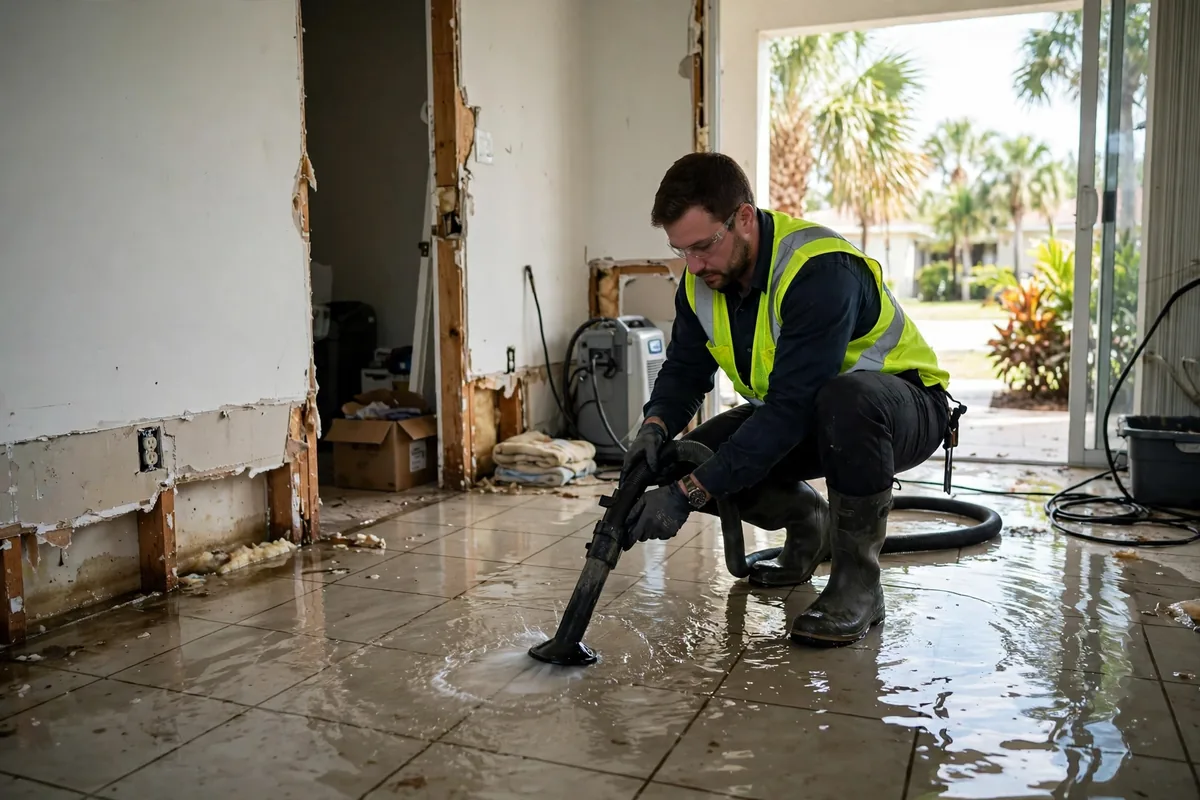
Every job begins with water extraction — pumps and vacuums remove standing water, using a submersible pump where flood water is deep — then structural drying takes over: air movers push air across wet surfaces while dehumidifiers strip moisture from the air. Materials that cannot be saved are removed so the structure behind them can dry, and cleaned surfaces get an antimicrobial treatment.
How aggressive all of this is depends on the water category. Category 1 is clean water from a supply line. Category 2, or gray water, carries dirt or chemicals — a washing machine overflow, for example. Category 3, or black water, is heavily contaminated: sewage backup and lagoon flood water are always Category 3 and demand the strictest handling and disposal.
The materials then set the limits. Drywall wicks water upward and is often cut above the wet line; wet insulation holds moisture against framing and rarely dries in place; carpet pad acts as a sponge and is typically removed. Hardwood flooring cups and warps, though fast drying sometimes saves it, while tile and grout hide moving water underneath, crossing the slab of a slab-on-grade home. Trying to let a Fort Pierce home dry on its own seldom works: humidity stays so high that evaporation stalls without equipment.
Safe First Steps While You Wait For A Pro
If water is still coming in, your first move is the main water shutoff — the valve that stops all water into the home, usually out at the meter. Close it if you can reach it safely, then call; for a single failed appliance, its own valve may be enough.
Protect people before property. Keep out of standing water near outlets, appliances or an electrical panel, and cut power to wet rooms at the breaker only from a dry spot. Never stand under a sagging, water-heavy ceiling, and treat flood and sewage water as contaminated — no wading, no bare hands, and keep children and pets away.
Skip the two instincts that cause harm: a household vacuum on standing or dirty water is an electric shock hazard, and household fans on contaminated water spread droplets through the room. Do not tear out flooring, baseboards or drywall before the damage is documented — what looks ruined is sometimes saveable, and early demolition can complicate a claim.
Documenting A Fort Pierce Claim
Claims are decided on evidence, so build yours in the first hours: photos and videos of every wet room, the source if visible, water lines on walls, and damaged belongings before anything is moved.
Get the drying file from the pro who does the work — moisture logs, the moisture map, and a written scope of work showing what was wet, dried and removed. Keep every receipt. Because Fort Pierce has both plumbing leaks and rising-water flooding, one question decides coverage early: homeowners insurance generally covers sudden pipe failures, while flood water from the lagoon or street belongs to a separate NFIP flood policy.
Related Services We Offer
Water Getting Worse Right Now?
Standing water, a burst pipe or sewage cannot wait. See what to do first — and call now.
Neighborhoods We Serve In Fort Pierce
Lincoln Park
Home to Zora Neale Hurston, author of Their Eyes Were Watching God
Avenue D Historic District
A named neighborhood inside Fort Pierce, in ZIP 34950.
Carver Heights
A named neighborhood inside Fort Pierce, in ZIP 34950.
Cortez Estates
A named neighborhood inside Fort Pierce, in ZIP 34950.
Downtown
A named neighborhood inside Fort Pierce, in ZIP 34950.
Downtown Historic District
A named neighborhood inside Fort Pierce, in ZIP 34950.
Edgartown
A named neighborhood inside Fort Pierce, in ZIP 34950.
Edgartown Historic District
A named neighborhood inside Fort Pierce, in ZIP 34950.
Neighborhoods we serve include:
- Avenue D Historic District
- Carver Heights
- Cortez Estates
- Downtown
- Downtown Historic District
- Edgartown
- Edgartown Historic District
- Fisherman's Wharf
- Lincoln Park
- Lost Tree Estates
- Maravilla
- Orange Blossom
- Paradise Park
- Peacock Arts District
- Performing Arts District
- River's Edge Historic District
- Sandalwood Estates
- South Beach
- Sunny Acres
- Sunrise Park
- Sunset Park
What Happens When You Call
You Call — It’s Free
One free call, answered 24/7. Tell us where the water is and what happened. There is no charge for the call and no obligation to book anything.
We Connect You With An Independent Local Pro
We match your call with an independent local water damage professional who serves your area — a separate local business, not our own crew.
The Pro Calls You Back Or Visits To Check The Problem
The pro can typically arrive in 30–60 minutes to check the problem in person, measure the moisture and explain the next steps before any work begins.
Why Fort Pierce Homeowners Use This Free Referral Service
We connect callers with independent local water damage pros — we are the referral line, not the crew. The call is free, there is no obligation to hire, and the pro who responds can typically arrive in 30–60 minutes, around the clock.
That simplicity counts in a city where half the homes rent and the housing stock is older: one number to call whether the problem is a rusted drain in Lincoln Park or surge water in South Beach. You explain the situation once, get matched with a local pro, and deal with that pro directly on plan and price.
What Homeowners Say
Reviews shown exactly as given to us (name, city, words) — we do not edit them.
“Reliable contractor. They showed up on schedule every day to check the moisture meters and adjust the drying fans. Our home is completely back to normal.”
Frank W. · Port St. Lucie, FL
“Competent team that clearly knows Florida building codes and moisture dynamics. Daily updates were clear and consistent.”
Gary V. · Jupiter, FL
“Dishwasher supply line snapped and flooded our newly renovated kitchen. The technicians were meticulous about drying behind the custom cabinetry without having to tear it all out. Impressive work.”
Linda H. · West Palm Beach, FL
ZIP Codes We Serve In Fort Pierce
Fort Pierce ZIP codes we serve: 34945, 34946, 34947, 34949, 34950, 34951, 34981, 34982. If your ZIP is not listed, call and we will confirm coverage.
Fort Pierce Water Damage Questions
Related Guides
Hurricane Season: Prepare Your Home For Water Damage
Guide — hurricane season water damage preparation
Why Saltwater Flooding Is Worse Than Freshwater
Guide — saltwater flooding damage to home
Flood Insurance In Florida: Why Homeowners Insurance Is Not Enough
Guide — flood insurance florida homeowners
Reviewed By Hamza
Role: CEO
Hamza is the CEO of this business. He is very expert in local business and has great experience.
Updated October 23, 2026
Sources
Water In Your Home Right Now?
One free call connects you with an independent local pro who can typically arrive in 30–60 minutes.
Free Call · Answered 24/7 · Local Pros Near You