
Free Referral Service — DeLand, Florida
Water Damage In DeLand, FL
Water damage in DeLand, FL has two faces: the pipe that bursts, and the storm that pushes the St. Johns River and local lakes over their banks. Add the septic systems and private wells many homes depend on, and a wet week can become a water-quality problem too. One free call connects you with an independent local pro who can typically arrive in 30–60 minutes, 24/7.
Free Call · Answered 24/7 · Local Pros Near You
Quick Answer: If your DeLand home has water damage, start the same day — and if flood water reached your septic tank or well, drinking water becomes a question too. DeLand has 41,611 residents and 17,078 homes; 34.2% of homes predate 1980, nearly identical to the Florida state value of 34.0%. The city averages 55.49 inches of rain a year, with flood zones A, AE and AO mapped locally. One free call connects you with an independent local pro who can typically arrive in 30–60 minutes.
Do I Have This Problem?
Tap every sign you see at home. This is a guide, not a diagnosis — only a pro can confirm the problem.
DeLand At A Glance
How DeLand Compares
Rankings are among the 19 Florida cities we serve. Sources: U.S. Census Bureau ACS 2024 5-year estimates; NOAA 1991–2020 Climate Normals. Method: each city is ranked 1 = highest (median year built: 1 = oldest) from data/cities.csv — see the sources list at the bottom of this page.
What Are The Early Signs Of Water Damage In A DeLand Home?
The first signs are quiet ones: a brown ring on the ceiling, paint bubbling along one wall, a room that smells earthy however often it is cleaned. They deserve a same-week look — mold growth can start in 24-48 hours on damp material.
- Water stains that grow, or paint and plaster that blister
- A musty odor in a closed-up room, closet or crawlspace
- Baseboards swelling, or wood floors that start to cup and lift
- A water bill that jumps, or a meter dial spinning with nothing running
The meter test finds what your city water utility (the service behind your tap water and bill) cannot: read the meter, use no water for an hour, read it again. Movement means water is escaping somewhere it should not.
Your safe first steps are simple: shut off the water at the main valve if you can reach it safely, keep clear of standing water near outlets, and move dry belongings out of the wet rooms while you wait for the pro.
What Causes Most Water Damage In DeLand?
Inside DeLand homes, the usual suspects are plumbing and appliances: a burst pipe, a leaking water heater, a dishwasher line that lets go. With a median home built in 1996, failures happen in the historic districts and the newer subdivisions alike.
Older streets hold the deeper risks. A cast iron drain pipe corrodes from the inside until it cracks, and galvanized steel pipe narrows with rust until pressure finds the weak point. Slab leaks develop in lines under the concrete slab. An AC condensate overflow, when the drain pan's line clogs, spills water into attics and wall cavities for days. Even a roof leak can mimic a plumbing failure — the stain appears rooms from the entry point.
How Do The St. Johns River, Lakes And Heavy Rain Flood DeLand?
DeLand floods from the sky and from the river. The city averages 55.49 inches of rain a year — the 8th highest average of the 19 Florida cities we serve — and the St. Johns River rises slowly and stays high for days after big storms.
Saturated ground leaves nowhere for new water to go, so flash flooding fills low streets and yards while river and lake levels creep toward homes in mapped hazard areas. Federal flood zones A, AE and AO are mapped in the city area; a FEMA flood zone AE property sits in a high-risk area with a set base flood elevation. During the Atlantic hurricane season, wind-driven rain adds roof and window leaks to the ground flooding.
Check your parcel before storm season at the FEMA Map Service Center — your zone decides your risk and whether flood insurance is required on your mortgage.
What Happens To Septic Systems And Private Wells After Flooding?
When flood water covers a DeLand yard, the systems buried in it need patience. A septic system — the underground tank and drainfield treating a home's wastewater where no sewer line runs — cannot treat anything while its drainfield is underwater, and a private well can draw contaminated surface water in through its cap or casing.
Until the ground dries, use as little water indoors as you can: skip laundry and long showers, and do not pump the tank while soil is saturated — an empty tank in wet ground can shift, and early pumping stirs solids into the drainfield. Keep people and pets off any area where sewage surfaced; that water is Category 3 contamination.
For the well, treat the water as undrinkable until it has been disinfected and tested after the water recedes; use bottled water until the test comes back clean.
How Do Pros Find Water Hiding In Walls And Floors?
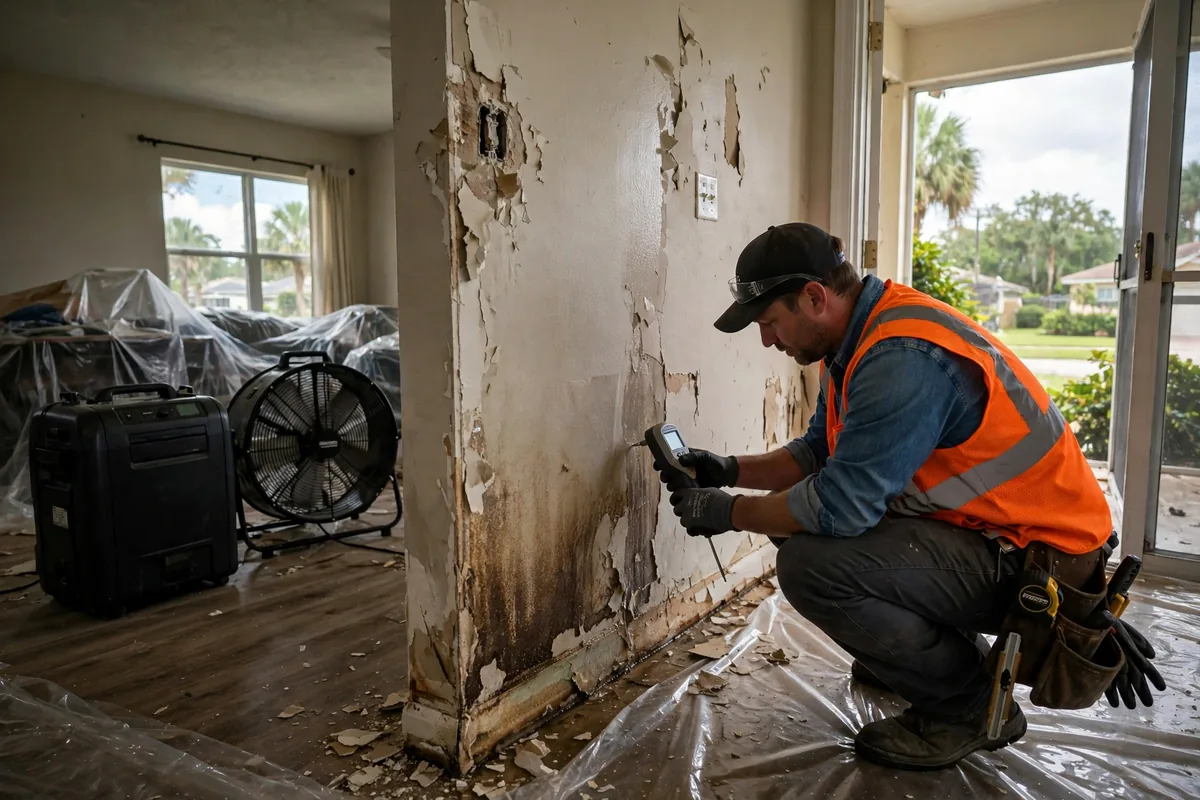
Pros trace hidden water with instruments, testing materials room by room to build a moisture mapping record — a diagram of readings showing exactly how far the water traveled.
A moisture meter measures dampness inside drywall, wood and flooring, and a thermal imaging camera turns it into a picture: wet material cools as it evaporates, so the damp path shows against dry surroundings, often pointing back to the source. Cavity and subfloor readings decide whether a section dries in place or comes out.
Readings repeat daily, and drying is finished only when materials reach their dry standard — the moisture level of the same material in an unaffected room — not when a surface feels dry.
How Does Drying Work — And What Are Water Categories 1, 2 And 3?
Drying starts with removal: standing water is pulled out with extraction equipment, then structural drying — air movers and dehumidifiers — runs until readings say stop. Materials that cannot recover are removed, and an antimicrobial treatment finishes surfaces.
The water category decides how the work is handled. Category 1 is clean supply water. Category 2 is used water with dirt or chemicals, like a washing machine discharge. Category 3 is the dangerous class — sewage, river water and any outside flood water — and it changes everything: protective equipment, disposal rules, and which materials can be saved.
A historic wood-frame cottage dries slowly — water wicks deep into old timber and plaster. Drywall saturates fast and often must be cut; wet insulation slumps against the studs; carpet pad usually cannot be salvaged. Letting the house dry itself is a gamble DeLand's humidity usually wins.
What Should You Do First — And What Should You Never Do?
Start by stopping the water at the main water shutoff, the valve where the main line enters the house, if you can reach it without wading. Then call — help matters most in the first day.
Safety rules come before property rules. Never walk through water that may touch outlets, appliances or a panel. Stay clear of sagging, bulging ceilings. If flood or sewage water is involved, keep skin contact at zero and children and pets out entirely.
Resist two urges. Do not drag a household vacuum across standing water — a plug-in motor in water is a shock hazard. And do not tear out baseboards, drywall or flooring to 'help': undocumented tear-out can scatter contamination and damage the paper trail a claim depends on. Photograph first; let measurements lead.
How Do DeLand's Neighborhoods Differ In Water Risk?
DeLand's risk map is two maps: the old city and the new. The Downtown DeLand Historic District — along Woodland Boulevard, with its 19th-century buildings — the Garden District and the West DeLand Residential Historic District hold the oldest housing, where original plumbing, wood rot in damp framing and tired roofs generate most calls.
The Victoria communities — Victoria Park, Victoria Hills, Victoria Oaks, Victoria Commons and Victoria Trails, plus Cresswind at Victoria Gardens (all ZIP 32724) — are newer subdivisions where appliance failures, AC drain overflows and slab issues in low spots dominate. Brandywine and Spring Hill (ZIP 32720) fall between the two patterns.
Citywide: median year built 1996, 34.2% of homes pre-1980 against a Florida state value of 34.0%, and 64.4% owner-occupied versus 67.6% statewide (U.S. Census Bureau, ACS 2024).
How Should You Document DeLand Water Damage For Insurance?
Photograph each affected room before anything moves, capture the water source if it is visible, and keep damaged items until the insurer has seen or released them.
Get the pro's records into the same file — moisture logs, the moisture map, and a written scope of what was dried and removed. For flood losses, remember the split: rising water from outside is generally a National Flood Insurance Program (NFIP) matter, not a standard homeowners claim, so the paperwork starts with identifying which water — and which policy — you are dealing with.
Related Services We Offer
Water Getting Worse Right Now?
Standing water, a burst pipe or sewage cannot wait. See what to do first — and call now.
Neighborhoods We Serve In DeLand
Downtown DeLand Historic District
Downtown DeLand's main street is Woodland Boulevard, which has a number of notable 19th-century buildings (Wikipedia).
Brandywine
A named neighborhood inside DeLand, in ZIP 32720.
Cresswind at Victoria Gardens
A named neighborhood inside DeLand, in ZIP 32724.
Garden District
A named neighborhood inside DeLand, in ZIP 32720.
Spring Hill
A named neighborhood inside DeLand, in ZIP 32720.
Stetson University Historic District
A named neighborhood inside DeLand, in ZIP 32720.
Victoria Commons
A named neighborhood inside DeLand, in ZIP 32724.
Victoria Hills
A named neighborhood inside DeLand, in ZIP 32724.
Neighborhoods we serve include:
- Brandywine
- Cresswind at Victoria Gardens
- Downtown DeLand Historic District
- Garden District
- Spring Hill
- Stetson University Historic District
- Victoria Commons
- Victoria Hills
- Victoria Oaks
- Victoria Park
- Victoria Trails
- West DeLand Residential Historic District
What Happens When You Call
You Call — It’s Free
One free call, answered 24/7. Tell us where the water is and what happened. There is no charge for the call and no obligation to book anything.
We Connect You With An Independent Local Pro
We match your call with an independent local water damage professional who serves your area — a separate local business, not our own crew.
The Pro Calls You Back Or Visits To Check The Problem
The pro can typically arrive in 30–60 minutes to check the problem in person, measure the moisture and explain the next steps before any work begins.
Why DeLand Homeowners Use This Free Referral Service
We are the connection, not the contractor: a single free call links you with an independent local water damage pro, and you never pay for the call or owe anything.
That simplicity counts when a pipe bursts at 3 a.m. or the yard is underwater — one number, one conversation, and a pro who can typically arrive in 30–60 minutes takes it from there, working directly with you on their own terms.
What Homeowners Say
Reviews shown exactly as given to us (name, city, words) — we do not edit them.
“Honest and dependable. They assessed water intrusion after a coastal squall and advised me on exactly what needed removal versus what was salvageable. Saved me thousands.”
Stephanie E. · Daytona Beach, FL
“A clogged HVAC condensation drain flooded our ceiling and hallway. They dried the attic insulation and hallway walls before any mold could form.”
Kimberly F. · Sanford, FL
“Honest pricing, quick dispatch, and respectful workers. They saved our laminate flooring from buckling. Would hire them again without hesitation.”
Jeffrey P. · Apopka, FL
ZIP Codes We Serve In DeLand
DeLand ZIP codes we serve: 32720, 32723, 32724. If your ZIP is not listed, call and we will confirm coverage.
DeLand Water Damage Questions
Related Guides
Is Your Well Water Safe After Flooding?
Guide — well water safety after flooding
Septic System Care After Flooding
Guide — septic system care after flooding
Hurricane Season: Prepare Your Home For Water Damage
Guide — hurricane season water damage preparation
Reviewed By Hamza
Role: CEO
Hamza is the CEO of this business. He is very expert in local business and has great experience.
Updated October 23, 2026
Sources
Water In Your Home Right Now?
One free call connects you with an independent local pro who can typically arrive in 30–60 minutes.
Free Call · Answered 24/7 · Local Pros Near You