
Reviewed By Hamza · CEO · Updated October 23, 2026
King Tides And Tidal Flooding In Florida
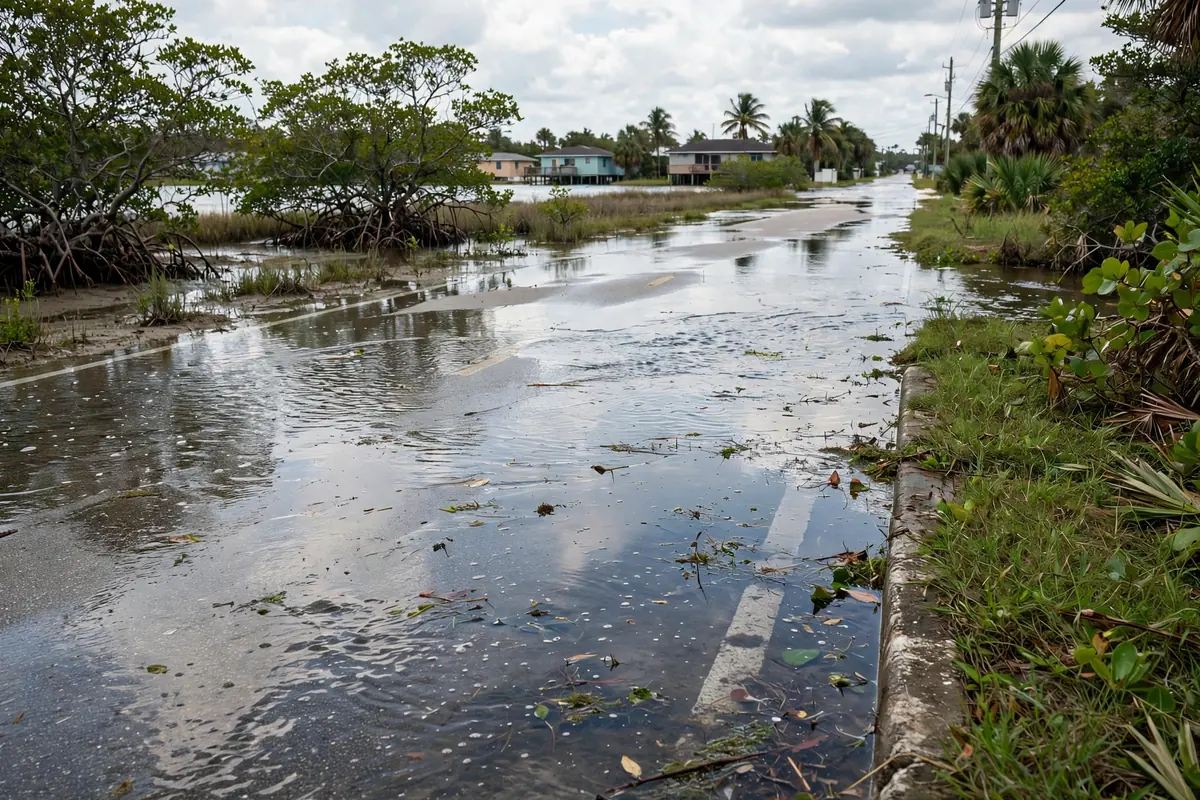
What are king tides? They are the highest tides of the year — and in coastal Florida they can flood streets on a sunny day. On a clear, calm morning in coastal Florida, seawater can rise out of storm drains and pond across streets with no rain at all. That is a king tide: one of the highest tides of the year, high enough to flood low neighborhoods on its own. This guide explains what causes these peak tides, how tidal flooding reaches homes that never see a storm, how saltwater intrusion makes this water more damaging than ordinary flood water, and the practical steps coastal homeowners in places like Dunedin, North Miami Beach, and Fort Pierce can take before, during, and after the water comes up.
In This Guide
What Are King Tides?
A king tide is an unusually high tide — the highest predicted tide of the year at a given place — that happens when the sun, moon, and Earth line up so their gravitational pull on the ocean adds together. It is not a storm and not a wave: it is the normal tide cycle at its yearly peak.
NOAA, the National Oceanic and Atmospheric Administration — the U.S. agency for weather, oceans, and climate information — predicts these tides well in advance, because they follow astronomy, not weather. In Florida the highest tides usually arrive in the fall, when seasonal winds and warm ocean water push sea level a little higher on top of the astronomical peak. The National Weather Service, NOAA's service that issues local forecasts and flood advisories, will often flag coastal flood statements for the highest-tide weekends. The key fact for homeowners: this flooding arrives on a schedule you can look up months ahead, which makes it one of the most preventable kinds of water damage there is.
Why King Tides Flood Streets With No Rain At All
These tides flood dry ground because Florida's coastal drainage runs downhill to the sea — and at the year's peak, the sea is temporarily higher than the drains. Water backs up through storm drains and canals, ponds in low streets, and soaks into ground that is already wet from a high water table, groundwater sitting close to the surface, common in Florida.
Once the ground is saturated, the water looks for the next-lowest path: under garage doors, across patios, and against the slab edge of a slab-on-grade home, the standard Florida house type built directly on a concrete slab. It does not need to pour over a doorstep to do damage — an inch of standing water against a home for a few hours, repeated over several days of high tides, wets the baseboard, the trim strip where a wall meets the floor, and the bottom of the drywall behind it. Add even ordinary rain on top of a peak tide and the system has nowhere to put it, which is why sunny-day flooding can turn into flash flooding, sudden fast-rising water from heavy rain, when a downpour lands at high tide.
King Tide Water Is Not Storm Surge — But It Is Still Salt Water
Tidal water and storm surge are both seawater in your street, but they are different events: a peak tide is a predictable high point on a calm day, while storm surge, sea water pushed inland by a hurricane or tropical storm, arrives violently, rises far higher, and is treated as contaminated water from the first minute.
The distinction matters for preparation, not for complacency. A storm drives surge with wind and waves that can destroy; a high tide simply rises, stands, and drains away — but it can do that several days in a row, twice a day, and it carries the same salt into the same walls. During the Atlantic hurricane season, the June 1 to November 30 period when tropical storms can affect Florida, a storm passing offshore can stack its surge on top of a seasonal high tide and produce flooding worse than either alone. Think of these tides as the rehearsal schedule for your home's flood weak points: every place tidal water reaches in October is a place surge water will reach further in a storm.
What Saltwater Does Inside A Home
The real harm in tidal water is the salt it leaves behind: saltwater intrusion, salt water from surge or tides entering a home or the ground, speeds up corrosion of fasteners, wiring, and HVAC equipment long after the floor looks dry. Fresh water mostly wets a home; salt water wets it and then keeps eating it.
Salt is hygroscopic — it pulls moisture out of the air — so salt-contaminated drywall, the gypsum wall board that soaks up water and swells, can stay damp and feed mold growth, colonies of mold that grow on wet materials, even in an air-conditioned room. Metal junction boxes, appliance feet, and the screws holding your cabinets can corrode from a single soaking if the salt is not cleaned away. Tidal water also crosses streets, yards, and drains on its way in, so it should be treated as dirty water: it can carry bacteria and chemicals, and a rising tide can push a sewage backup, waste water reversing into the home through drains, into low bathrooms in older neighborhoods. Drying alone is not the full fix for salt water — the salt itself has to be cleaned off surfaces, which is one reason tidal flooding is a pro job more often than homeowners expect.
Before, During And After A King Tide: Safe Steps
Before a predicted high tide, move belongings off garage and ground-floor surfaces, check that door thresholds and garage seals are intact, and photograph your home's current condition. Because these tides are forecast well ahead, there is no reason for this water to surprise you indoors.
During the tide, stay out of the water where you can, and never drive through flooded streets — the depth is deceptive and the water hides open drains. A submersible pump, an electric pump placed directly in standing water, can move water out of a garage or patio once the tide turns, but only if you can run it safely without standing in the water yourself. After the water drains, treat the clean-up like any water damage: remove wet porous items, clean hard surfaces, and start drying fast, because mold can start within 24 to 48 hours. An antimicrobial treatment, a cleaning product applied to surfaces to slow mold and bacteria growth, is commonly applied after salt water is cleaned. Document everything with photos before you clean — repeated tidal losses are exactly the history an insurer or a flood-policy adjuster will ask about.
Check Your Flood Zone And Think About Flood Coverage
Find your home's flood zone before you need it: FEMA, the Federal Emergency Management Agency, publishes the maps that classify land as FEMA flood zone AE, a mapped high-risk flood area with a 1 percent annual chance of flooding, or FEMA flood zone VE, a mapped coastal high-risk area where wave action adds to the hazard. When king tides already reach your street, those zones are not abstract — they are describing your block.
Standard homeowners insurance typically does not cover rising water, including tidal flooding. Flood coverage is separate, through the National Flood Insurance Program (NFIP), the federal flood insurance program that offers policies through insurers because standard policies exclude flood. Ready.gov, the federal preparedness site, walks through how flood policies work and why they usually have a waiting period before they take effect — another reason to arrange coverage in a calm month, not during a high-tide weekend. If tidal water has entered your home more than once, that conversation is overdue.
If water does get in, this site is a free referral service, not the contractor: one free call connects you with an independent local pro who can typically arrive in 30–60 minutes to check moisture in walls and floors and start proper drying. Salt water rewards fast, thorough work and punishes waiting.
Not Sure How Bad It Is?
One free call connects you with a local pro who can check it in person — typically within 30–60 minutes.
Related Guides
Hurricane Season: Prepare Your Home For Water Damage
Guide — hurricane season water damage preparation
Why Saltwater Flooding Is Worse Than Freshwater
Guide — saltwater flooding damage to home
Reviewed By Hamza
Role: CEO
Hamza is the CEO of this business. He is very expert in local business and has great experience.
Updated October 23, 2026
Sources
Water In Your Home Right Now?
One free call connects you with an independent local pro who can typically arrive in 30–60 minutes.
Free Call · Answered 24/7 · Local Pros Near You