
Free Referral Service — North Miami Beach, Florida
Water Damage In North Miami Beach, FL
Water damage in North Miami Beach, FL starts from a tough hand: the oldest housing on our list, 80.6% of homes built before 1980, and the heaviest rainfall, over 68 inches a year. When water shows up where it should not be, one free call connects you with an independent local pro who can typically arrive in 30–60 minutes.
Free Call · Answered 24/7 · Local Pros Near You
Quick Answer: North Miami Beach's 43,898 residents live in 17,533 homes, and 80.6% of those homes predate 1980 — the highest share of the 19 Florida cities we serve, compared with 34.0% statewide (U.S. Census Bureau, ACS 2024). Flood zones AE and X are mapped in the city, wrapped by canals and the Intracoastal, and 68.33 inches of rain falls in an average year. Old pipes plus that much water means leaks are frequent. One free call connects you with an independent local pro who can typically arrive in 30–60 minutes.
Do I Have This Problem?
Tap every sign you see at home. This is a guide, not a diagnosis — only a pro can confirm the problem.
North Miami Beach At A Glance
How North Miami Beach Compares
Rankings are among the 19 Florida cities we serve. Sources: U.S. Census Bureau ACS 2024 5-year estimates; NOAA 1991–2020 Climate Normals. Method: each city is ranked 1 = highest (median year built: 1 = oldest) from data/cities.csv — see the sources list at the bottom of this page.
What Are The Early Warning Signs In A North Miami Beach Home Or Condo?
The first signs are sensory, not visual: a musty odor in a room that never airs out, then paint that blisters, trim that swells, or a patch of floor that feels softer than the rest. Act the same week: mold growth on damp material can start in 24-48 hours.
- Ceiling stains or bubbling paint, especially below a bathroom or an upstairs unit
- A musty smell with no visible water — often a slow drip inside a wall cavity, the enclosed space between wall surfaces
- Swollen baseboards and cabinetry — the built-in kitchen and bath cabinets — that no longer sit flush
- Laminate flooring that lifts or feels spongy, or a water bill that suddenly jumps
In a condo, water on your ceiling usually started in the unit above, so notify the building too. Your city water utility can confirm a usage spike — often the first evidence of a hidden leak.
What Starts Most Water Damage Here?
Plumbing and appliances start most of it. The median home was built in 1967 — the oldest median of the 19 Florida cities we serve — so the pipes themselves are the leading cause, with air conditioning a close second.
Original galvanized steel pipe — the zinc-coated steel used for mid-century supply lines — rusts inward until seams weep, and cast iron drain pipe under the slab corrodes the same way. Because most homes are slab-on-grade, built directly on a concrete slab with no crawlspace, a slab leak can push water up through the floor for weeks before it shows. An AC condensate overflow happens when algae blocks the drain line from the air handler, the indoor half of the AC system; the pan spills into the ceiling below, sometimes for weeks. A burst pipe or an appliance leak — a washer hose, a dishwasher line, a water heater rusting through — is the faster disaster, and a sewage backup is the worst: Category 3 water, grossly contaminated.
Only 52.2% of homes here are owner-occupied, versus 67.6% statewide, so many leaks happen in rentals and condos. Report fast, in writing.
How Do Record Rain, King Tides And The Canals Add To The Risk?
North Miami Beach is one of Florida's wettest cities: 68.33 inches of rain a year on average (NOAA 1991–2020 normals, North Miami Beach #2 station), the most of the 19 Florida cities we serve. The city also sits low — about 8.9 feet at its Census survey point (USGS) — threaded with canals.
Three patterns follow. Flash flooding fills streets and ground floors within minutes during a cloudburst. A king tide, the year's highest tide, can push canal water back through storm drains on a sunny day. And in Atlantic hurricane season, a hurricane can drive storm surge into the canals while wind-driven rain forces water under roof tiles. Federal maps show zones AE and X here: a FEMA flood zone AE is the high-risk zone with a published base flood elevation, and most canal-side parcels fall in it — check yours at msc.fema.gov. Rising water needs flood insurance: a homeowners policy excludes it, and a new National Flood Insurance Program (NFIP) policy takes 30 days to start.
How Do Pros Find The True Extent Of The Damage?
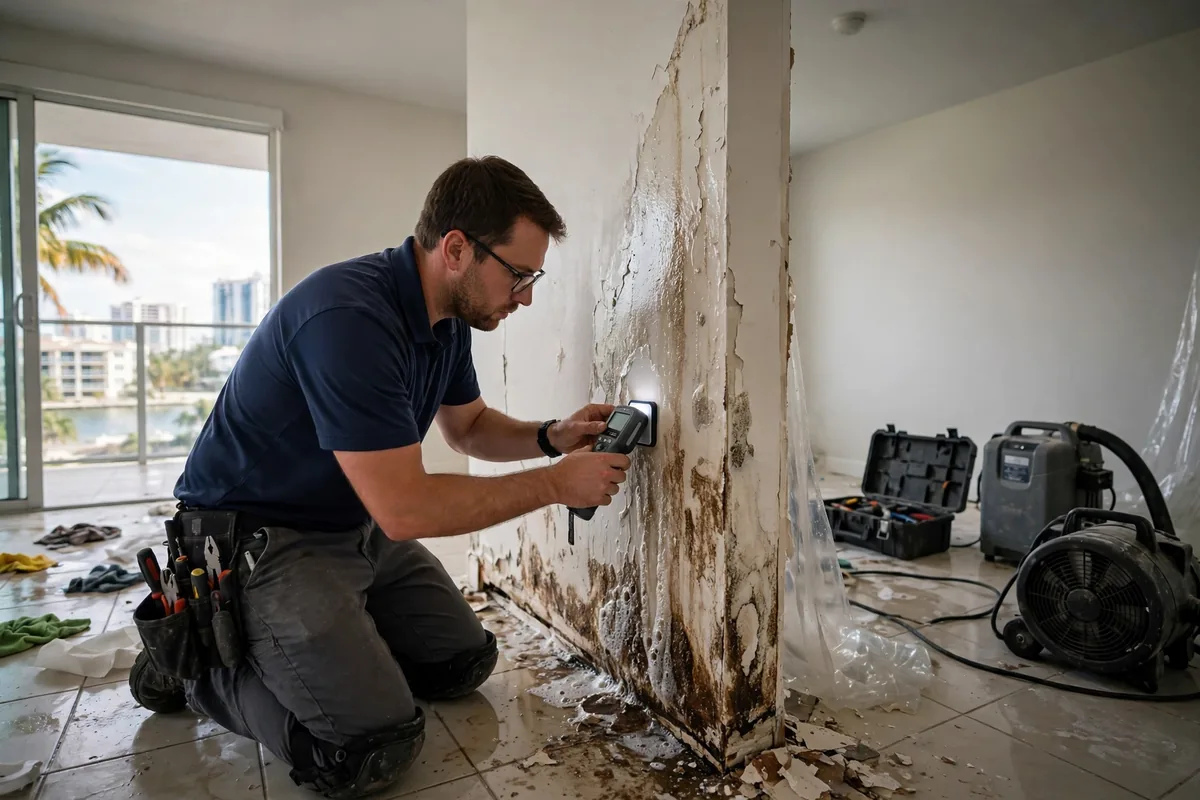
Pros measure instead of guessing: a moisture survey shows which walls, floors and cabinets are wet, even ones that look untouched.
The core tool is a moisture meter, which reads the water content inside a material without opening it. Moisture mapping turns readings into a drawn map of the wet footprint, and a thermal imaging camera often shows the cool trail of water spreading inside a wall or under a floor. The survey continues during drying: daily monitoring at the same points until everything reaches the dry standard — the moisture level of the same material in a dry part of the home. That log proves the home is dry and documents the job for your insurer.
How Does Drying Work, And Why Does The Water Category Change The Plan?
Drying is a sequence: extract the liquid water, dry the structure with controlled airflow and dehumidification, then clean and treat surfaces. The category of the water sets how much material can stay.
Extraction comes first. Then structural drying — drying the building materials in place — uses an air mover to sweep air across wet surfaces and an LGR dehumidifier, a refrigerant unit that keeps pulling moisture out as the air dries. Antimicrobial treatment on cleaned surfaces discourages mold while drying finishes.
Categories decide removals. Category 1 is clean supply water; Category 2 is gray water with soil or chemicals; Category 3 — sewage and flood water — means carpet pad and wet insulation usually come out rather than being dried. Drywall wicks water upward behind paint, tile and grout can hide water spreading across the slab, and Florida humidity defeats open-window drying, so the equipment runs in a closed space.
What Should You Do Right Away — And What Should You Never Attempt?
Do three things first: shut the water off, get people clear of hazards, and make the call. The main water shutoff — the valve that stops all water entering the home — is usually at the meter or where the line enters; closing it stops a leak from doing more damage while you wait.
Respect the hazards. Never wade through water that may be touching outlets or a breaker panel, and keep children and pets away from sewage or canal water inside the home. A sagging, stained ceiling can drop wet drywall without warning — stay out from under it. In a condo, call the building too; the shutoff that matters may be theirs.
The never list is short. Do not use a household vacuum on water — it is a genuine shock risk. Do not aim household fans at sewage or flood water; you will spread contaminants through the home. Do not tear out flooring, drywall or cabinets: removing materials that cannot be saved belongs in the pro's documented sequence, and early demolition can complicate your claim. Photograph everything first and move what is dry to a dry room.
How Do The Neighborhoods And Condo Buildings Differ?
Risk here changes street by street. Eastern Shores, the city's best-known neighborhood, is a guard-gated peninsula of man-made canals in ZIP 33160 — nearly every home fronts the water, so seawalls, king tides and surge define its risk, along with saltwater intrusion — salt water creeping where only fresh water belongs, corroding pipes faster. Sky Lake, Sunray East and Sunray West are inland subdivisions of the same building era, where aging drains and slab leaks dominate. Uleta and Windward sit toward the western canals, and City Center holds much of the denser housing.
Condos change the responsibility picture. A tower leak may involve the unit above, the association and you — and two policies: your HO-6 condo policy for your unit's interior, and the association's master policy for the structure. Photograph before anyone cleans, report in writing the same day, and keep the pro's moisture records.
What Records Should You Keep For Insurance?
Start a file the day you find the water; good records turn a stressful week into a paid claim.
Photograph every affected room before cleanup. Save the pro's paperwork — the moisture map, the daily log showing the dry standard was reached, and the scope of work. Keep receipts and damaged belongings until the adjuster clears them. Note who you notified and when; rising-water damage runs through flood insurance, not your homeowners policy.
Related Services We Offer
Water Getting Worse Right Now?
Standing water, a burst pipe or sewage cannot wait. See what to do first — and call now.
Neighborhoods We Serve In North Miami Beach
Eastern Shores
Guard-gated peninsula neighborhood made up of man-made canals; its sole ZIP code is 33160 (Wikipedia).
City Center
A named neighborhood inside North Miami Beach, in ZIP 33160.
Sky Lake
A named neighborhood inside North Miami Beach, in ZIP 33160.
Sunray East
A named neighborhood inside North Miami Beach, in ZIP 33160.
Sunray West
A named neighborhood inside North Miami Beach, in ZIP 33160.
Uleta
A named neighborhood inside North Miami Beach, in ZIP 33160.
Windward
A named neighborhood inside North Miami Beach, in ZIP 33160.
Neighborhoods we serve include:
- City Center
- Eastern Shores
- Sky Lake
- Sunray East
- Sunray West
- Uleta
- Windward
What Happens When You Call
You Call — It’s Free
One free call, answered 24/7. Tell us where the water is and what happened. There is no charge for the call and no obligation to book anything.
We Connect You With An Independent Local Pro
We match your call with an independent local water damage professional who serves your area — a separate local business, not our own crew.
The Pro Calls You Back Or Visits To Check The Problem
The pro can typically arrive in 30–60 minutes to check the problem in person, measure the moisture and explain the next steps before any work begins.
Why North Miami Beach Residents Start With A Free Call
We run a referral service — we are not the company that will dry your home. One free call connects you with an independent local water damage pro; the pro inspects, quotes and does the work, and your agreement is with them, not us.
That helps in a city of older homes and condo buildings, where the first question is who can come and measure the problem now. The pro who responds can typically arrive in 30–60 minutes, around the clock, and you decide after the inspection whether to hire them. No charge for the call, and no obligation.
What Homeowners Say
Reviews shown exactly as given to us (name, city, words) — we do not edit them.
“Woke up to three inches of water in our ground-floor condo from an AC drain line backup. These technicians were absolute lifesavers. They mitigated the moisture and handled all communication directly with our insurance adjuster.”
Marco V. · Miami, FL
“Excelente servicio. The crew arrived quickly, removed all soaked baseboards, and treated the area for antimicrobials so mold wouldn't stand a chance in the Florida heat. Thank you!”
Maria C. · Hialeah, FL
“A reverse osmosis filter cracked under the kitchen sink and flooded our first floor. Their technicians extracted the water and used HEPA air scrubbers. Zero musty smell!”
Laura T. · Doral, FL
ZIP Codes We Serve In North Miami Beach
North Miami Beach ZIP codes we serve: 33160. If your ZIP is not listed, call and we will confirm coverage.
North Miami Beach Water Damage Questions
Related Guides
Renters And Water Damage: Who Pays For What
Guide — does renters insurance cover water damage
King Tides And Tidal Flooding In Florida
Guide — what are king tides
Condo Leak? Who Is Responsible — You, The HOA, Or The Unit Above
Guide — does condo insurance cover water damage
Reviewed By Hamza
Role: CEO
Hamza is the CEO of this business. He is very expert in local business and has great experience.
Updated October 23, 2026
Sources
Water In Your Home Right Now?
One free call connects you with an independent local pro who can typically arrive in 30–60 minutes.
Free Call · Answered 24/7 · Local Pros Near You