
Free Referral Service — Winter Springs, Florida
Water Damage In Winter Springs, FL
Water damage in Winter Springs, FL tends to hide in the walls of the city's 1980s-era neighborhoods long before it shows on a ceiling. With 49.63 inches of rain a year, even a slow drip deserves a same-day look. A single free call puts you in touch with an independent local pro who can typically arrive in 30–60 minutes, day or night.
Free Call · Answered 24/7 · Local Pros Near You
Quick Answer: Do not wait on water damage in Winter Springs — wet materials here can grow mold within a day or two. The city counts 38,951 residents and 16,020 homes, and 23.3% of those homes were built before 1980, so aging supply lines are a steady source of leaks. Federal maps show flood zones A, AE, AH and X in the area, and lake-country drainage backs up in summer storms. One free call connects you with an independent local pro.
Do I Have This Problem?
Tap every sign you see at home. This is a guide, not a diagnosis — only a pro can confirm the problem.
Winter Springs At A Glance
How Winter Springs Compares
Rankings are among the 19 Florida cities we serve. Sources: U.S. Census Bureau ACS 2024 5-year estimates; NOAA 1991–2020 Climate Normals. Method: each city is ranked 1 = highest (median year built: 1 = oldest) from data/cities.csv — see the sources list at the bottom of this page.
How Can You Tell There Is Hidden Water Damage In Your Winter Springs Home?
Hidden damage usually announces itself quietly: a ceiling ring that grows, paint that bubbles, or one room that smells musty while the rest of the house smells fine. In Winter Springs' mature, tree-shaded neighborhoods, these signs often trace back to a slow plumbing leak.
Six things worth checking today:
- Water stains or peeling, bubbling paint on ceilings and walls
- A musty odor with no visible water — the classic smell of a damp wall cavity, the hollow space inside a framed wall
- Swollen baseboards or flooring that feels warped, cupped or springy underfoot
- A water bill jump, or a water meter that keeps turning with every tap off
- Flooring that feels warm in one spot — a possible slab leak in a hot-water line under the concrete
- Any of the above getting worse fast, because mold growth can begin within 24-48 hours on wet material
Your city water utility — the city service that supplies your water and sends the bill — can flag a usage spike, but pinpointing the leak takes measurement inside the home.
What Usually Causes Water Damage In Winter Springs Homes?
In Winter Springs the leading causes are plumbing failures in the city's big 1970s–1990s building wave, AC drain clogs, and appliance leaks — storms add damage, but inside-the-house water does most of it.
The median home here was built in 1989, so much of the original plumbing is 30-plus years old. A burst pipe is often the end stage of pipe corrosion — the slow thinning of metal pipe walls — in aging copper pipe runs and in galvanized lines left in older sections; an aging cast iron drain pipe can crack and leak under the floor. Slab leaks form in lines buried in the concrete slab and can soak a floor for weeks. Appliance failures round out the list: a tired water heater, a split washer hose or a dishwasher leak can each dump gallons overnight. In summer, an AC condensate overflow — a clogged drain line backing water out of the air handler's pan — quietly soaks closets and ceilings.
How Do Winter Springs' Lakes And Flood Zones Change Your Risk?
Winter Springs sits in Seminole County lake country at modest elevation — the Census survey point is 22.7 feet — and FEMA maps flood zones A, AE, AH and X in the city area, so low lots near lakes and creeks carry real flood risk even though the city is inland.
FEMA flood zone AE is the mapped high-risk zone, with a 1 percent annual chance of flooding and a calculated base flood elevation; homes there with federally backed mortgages usually must carry flood cover through the National Flood Insurance Program (NFIP) — the federal program that sells flood policies regular homeowners insurance excludes. Everyday risk is more often rain-driven: a stalled storm can produce flash flooding on low streets, wind-driven rain finds gaps around vents and seals, and roof leak damage often shows up rooms away from the entry point. The high water table — groundwater sitting close to the surface — keeps soil under slabs damp through the rainy season, and during Atlantic hurricane season a single tropical system can drop a season's worth of rain in days.
Checking your own flood zone takes two minutes: enter your address at the federal Map Service Center, msc.fema.gov, before storm season.
How Does A Pro Track Down Water You Cannot See?
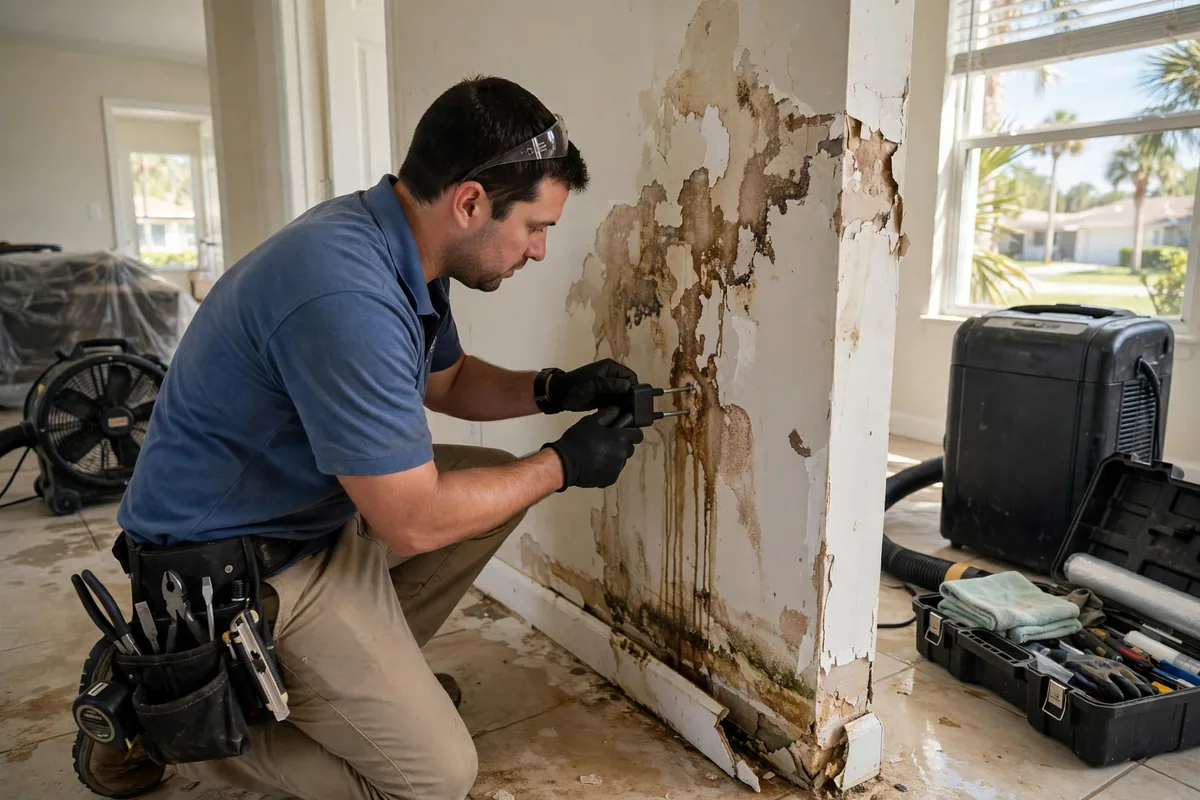
A pro locates hidden water by measuring, not by tearing out walls: readings across every surface build a map of how far the water travelled.
The kit is simple to explain. A moisture meter reads dampness below the surface of drywall, wood and tile; moisture mapping is the room-by-room record of those readings. A thermal imaging camera pictures temperature differences, so evaporating water shows as a cool patch that traces the leak's path.
Readings continue daily until each material meets its dry standard, the moisture level of the same material in an unaffected room. That verified finish is what stops mold from starting behind a wall that merely felt dry.
What Happens During Drying — And Why Does The Water Category Matter?
Drying runs in a fixed order: standing water is removed first, then the structure is dried with moving air and dehumidifiers, unsalvageable material comes out, and surfaces are cleaned and treated. How strict each step is depends on which of the three water categories you are dealing with.
Category 1 is clean water from a supply line. Category 2, gray water, has picked up dirt or chemicals — think washing-machine discharge. Category 3 is the dangerous one: sewage backup and outdoor flood water are always Category 3 and get containment and disposal rules to match.
The work itself starts with water extraction. Structural drying follows: an air mover pushes air across wet surfaces while a dehumidifier pulls the released moisture out of the air. Material that cannot be saved — soaked carpet pad, which holds water like a sponge, and crumbling drywall — is removed so the framing behind it can dry. Wet insulation inside a wall cavity usually comes out too, while hardwood flooring can sometimes be saved if drying starts the same day; tile and grout may look fine while water runs beneath them across the slab of a slab-on-grade home, the standard local build with the floor poured directly on the ground. An antimicrobial treatment — a spray that stops microbes growing on damp surfaces — finishes the job. Skipping equipment and 'letting it air out' rarely works here: Florida humidity keeps indoor air so moist that natural drying stalls halfway.
What Should You Do In The First Hour — And What Should You Avoid?
First, stop the source if you safely can: shut off the main water shutoff — where the line enters your home or at the meter — then make one free call.
Respect three hazards. Electricity and water are a lethal mix, so keep out of standing water near outlets, appliances or the breaker panel. A waterlogged ceiling can sag and collapse without warning — do not stand under one. And flood or sewage water is contaminated: keep skin contact to zero and keep children and pets out entirely.
Two 'helpful' moves actually cause harm. Never run a household vacuum on standing water — shock risk, especially with Category 3 water. And never tear out baseboards, drywall or flooring before the damage is photographed and a pro has judged what can be saved; early demolition spreads contamination and can undermine an insurance claim. Do take photos, move dry belongings to a safe room, and note when you first saw the damage.
Which Winter Springs Neighborhoods And Home Styles See The Most Damage?
The pattern in Winter Springs follows the building eras: the 23.3% of homes built before 1980 — the 13th-highest share of the 19 Florida cities we serve, against 34.0% statewide — carry the oldest plumbing, while the 1980s subdivisions are now old enough for original pipes and roofs to fail together.
Tuscawilla, the city's best-known neighborhood and home to Tuscawilla Country Club with a population over 11,000, mixes 1970s ranch homes with later builds, and water damage in Tuscawilla homes frequently starts with aging supply lines and AC drains. Oak Forest and The Highlands have similar-era stock under heavy tree canopy, where slow roof leaks are common. In newer subdivisions such as Seven Oaks and Carrington Woods, calls lean toward appliance leaks and condensate problems. Across the city, 76.1% of homes are owner-occupied (U.S. Census Bureau figures), so most readers are the ones who will pay for repairs.
How Do You Document Damage So An Insurance Claim Holds Up?
Insurers pay on paperwork, so build the file before cleanup erases the evidence: dated photos and video of every wet room, the failed part if you can see it, and anything the water touched.
Then keep the pro's records — the moisture map, daily logs and the written scope of work. Save receipts and keep removed materials until the adjuster releases them. If your lot sits in a mapped flood zone, flood water is usually a separate NFIP claim.
Related Services We Offer
Water Getting Worse Right Now?
Standing water, a burst pipe or sewage cannot wait. See what to do first — and call now.
Neighborhoods We Serve In Winter Springs
Tuscawilla
Home to Tuscawilla Country Club; population over 11,000
Avery Park
A named neighborhood inside Winter Springs, in ZIP 32708.
Barrington Estates
A named neighborhood inside Winter Springs, in ZIP 32708.
Carrington Woods
A named neighborhood inside Winter Springs, in ZIP 32708.
Country Club Village
A named neighborhood inside Winter Springs, in ZIP 32708.
Eagles Watch
A named neighborhood inside Winter Springs, in ZIP 32708.
Glen Eagle
A named neighborhood inside Winter Springs, in ZIP 32708.
Greenbriar
A named neighborhood inside Winter Springs, in ZIP 32708.
Neighborhoods we serve include:
- Avery Park
- Barrington Estates
- Carrington Woods
- Country Club Village
- Eagles Watch
- Glen Eagle
- Greenbriar
- Jesups Landing
- Jesups Reserve
- Mount Greenwood
- North Orlando Ranches
- North Orlando Terrace
- Oak Forest
- Parkstone
- Seminole Crossing
- Seven Oaks
- Seville Chase
- The Highlands
- Tuscawilla
- Tuskawilla Crossings
- Winding Hollow
- Winter Springs Village
What Happens When You Call
You Call — It’s Free
One free call, answered 24/7. Tell us where the water is and what happened. There is no charge for the call and no obligation to book anything.
We Connect You With An Independent Local Pro
We match your call with an independent local water damage professional who serves your area — a separate local business, not our own crew.
The Pro Calls You Back Or Visits To Check The Problem
The pro can typically arrive in 30–60 minutes to check the problem in person, measure the moisture and explain the next steps before any work begins.
Why Winter Springs Homeowners Call This Referral Line First
This page belongs to a referral service, not a restoration company: calling costs nothing, and the call connects you with an independent local water damage pro who does the work and answers for it.
That means one number at midnight or midday, no obligation to book, and a pro who can typically arrive in 30–60 minutes. Prices and the work itself are agreed between you and that pro directly.
What Homeowners Say
Reviews shown exactly as given to us (name, city, words) — we do not edit them.
“A clogged HVAC condensation drain flooded our ceiling and hallway. They dried the attic insulation and hallway walls before any mold could form.”
Kimberly F. · Sanford, FL
“Professional and courteous service. They took great care wrapping and protecting our wooden dining set while drying the floor beneath.”
Hannah G. · Altamonte Springs, FL
“Honest pricing, quick dispatch, and respectful workers. They saved our laminate flooring from buckling. Would hire them again without hesitation.”
Jeffrey P. · Apopka, FL
ZIP Codes We Serve In Winter Springs
Winter Springs ZIP codes we serve: 32708. If your ZIP is not listed, call and we will confirm coverage.
Winter Springs Water Damage Questions
Related Guides
Is Your Well Water Safe After Flooding?
Guide — well water safety after flooding
Septic System Care After Flooding
Guide — septic system care after flooding
How To Prevent Water Damage In A Florida Home
Guide — how to prevent water damage
Reviewed By Hamza
Role: CEO
Hamza is the CEO of this business. He is very expert in local business and has great experience.
Updated October 23, 2026
Sources
Water In Your Home Right Now?
One free call connects you with an independent local pro who can typically arrive in 30–60 minutes.
Free Call · Answered 24/7 · Local Pros Near You