
Free Referral Service — Ocoee, Florida
Water Damage In Ocoee, FL
Water damage in Ocoee, FL often starts out of sight — a clogged AC drain dripping into a ceiling, or a supply line leaking under the slab of a newer subdivision home. One free call connects you with an independent local pro who can typically arrive in 30–60 minutes, 24/7.
Free Call · Answered 24/7 · Local Pros Near You
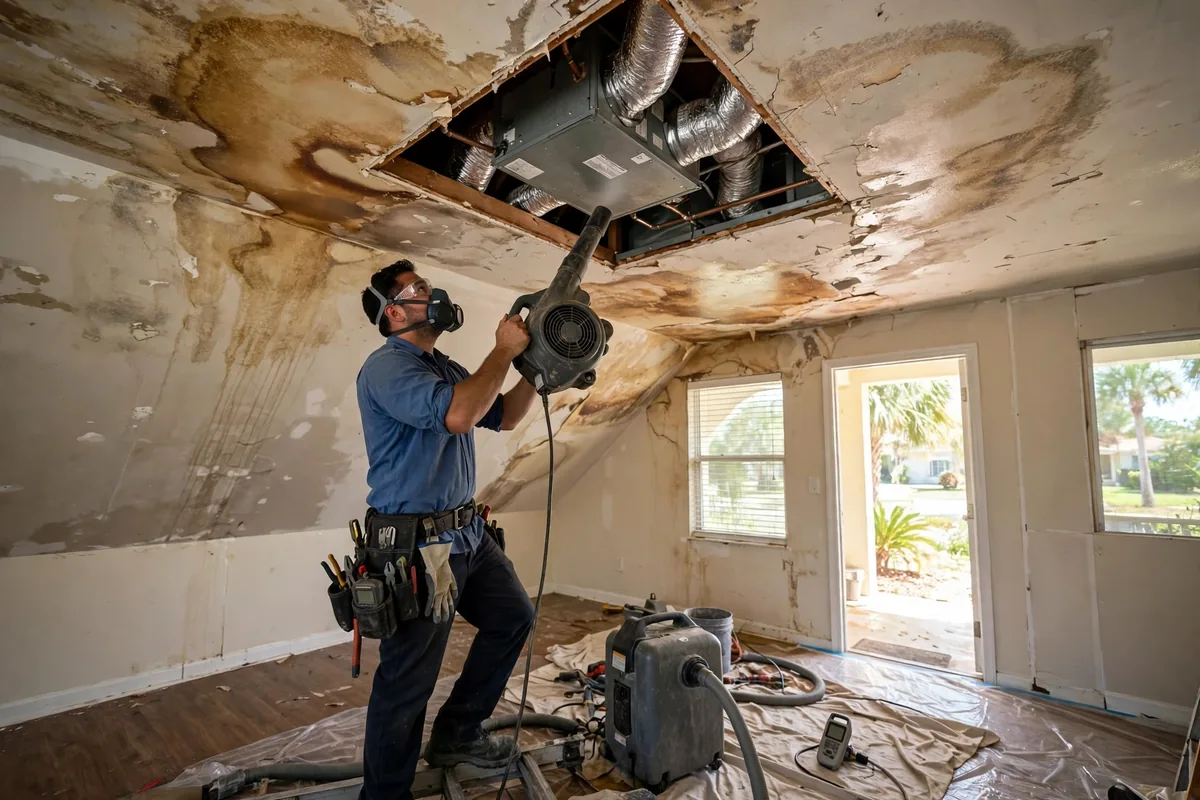
Quick Answer: Slow down the damage today: in Ocoee, minutes matter more than the size of the leak. The city has 49,033 residents and 16,492 homes, and although the median home was built in 2000, Federal flood zones A and AE are mapped around its many lakes, and 53.64 inches of rain fall in an average year. One free call connects you with an independent local pro who can typically arrive in 30–60 minutes.
Do I Have This Problem?
Tap every sign you see at home. This is a guide, not a diagnosis — only a pro can confirm the problem.
Ocoee At A Glance
How Ocoee Compares
Rankings are among the 19 Florida cities we serve. Sources: U.S. Census Bureau ACS 2024 5-year estimates; NOAA 1991–2020 Climate Normals. Method: each city is ranked 1 = highest (median year built: 1 = oldest) from data/cities.csv — see the sources list at the bottom of this page.
How Water Damage In Ocoee, FL Usually Shows Up
Look first for the quiet signs: a water stain spreading on a ceiling, a musty smell in a room that never quite airs out, and baseboards pulling away from the wall. In Ocoee those clues usually point to a slow leak running for days, not a one-time spill.
Other warnings worth acting on:
- Bubbling paint or soft, spongy spots in drywall — the gypsum wall board that soaks up water and swells
- Floors that feel warped or cupped, or tile that sounds hollow when you knock on it
- A water bill that jumps with no new sprinkler use, or a meter dial that keeps turning with every tap off
Do not wait for the stain to dry on its own. Mold growth can begin within 24-48 hours on wet material in Central Florida's warm air, and the longer water sits, the farther it reaches.
What Do Ocoee's Lakes And Flood Zones Mean For Your Home?
Most of Ocoee sits on high ground for Florida — the U.S. Geological Survey point reading is 157.8 feet — yet flood risk is real around the lakes. Federal flood zones A, AE and X are mapped in the city area, and the A and AE zones, the mapped high-risk areas, cluster along Lake Apopka and the smaller lakes between subdivisions.
Near the water, a high water table — groundwater sitting close to the surface — keeps soil under slabs damp through the rainy season, and a hard summer storm can overwhelm drainage in low pockets.
Before hurricane season, look up your flood zone at the Map Service Center, msc.fema.gov. If your home falls in zone A or AE and you carry a federally backed mortgage, flood insurance through the National Flood Insurance Program (NFIP) — federal flood coverage sold separately from homeowners insurance — is usually required.
What Causes Water Damage In Ocoee Homes?
In a city where the median home was built in 2000, the top cause is not old pipes — it is the air conditioner. An AC condensate overflow happens when the condensate drain line of the air handler clogs with algae and the pan spills into a ceiling or closet, often for days before a stain appears.
Close behind are appliance leaks: a split washing machine hose, a seeping dishwasher, or a water heater rusting through in the garage. A burst pipe in a wall, and slab leaks — pinhole leaks in lines under the concrete slab — round out the inside causes. Copper pipe and PEX pipe, the flexible plastic line common in newer builds, fail less often than old metal, but their joints still leak.
From outside, a roof leak fed by wind-driven rain can soak an attic far from the entry point. And in Ocoee's oldest pockets near downtown, where most homes were built before 1980, some still drain through a cast iron drain pipe or supply through galvanized steel pipe, both rusting from the inside. A sewage backup — drain water reversing into tubs and toilets — is the most serious cause of all, because that water is contaminated.
How Pros Find Moisture Hiding In Walls And Floors
A pro finds hidden water by measuring, not by tearing rooms apart: moisture meters read how wet each material is, and the readings are plotted into a moisture map of the home.
A moisture meter uses small pins — or a pinless moisture meter scans below the surface without holes — to check walls, wood and flooring room by room. Moisture mapping turns those readings into a clear picture of how far the water traveled. A thermal imaging camera helps too: damp areas read cooler on screen, tracing a leak's path before any wall is opened. A hygrometer, which measures the air's humidity and temperature, shows whether conditions allow drying.
Pros then verify with daily monitoring — repeat readings until each material reaches its dry standard, the normal moisture level of the same material in an unaffected part of the home.
How Standing Water Is Removed And A Home Is Dried
Drying starts with water extraction: standing water is pumped and vacuumed out, often with a truck-mounted extractor, first. Only then does structural drying — the planned drying of walls, framing and floors — begin.
An air mover, a powerful fan that pushes air across wet surfaces, speeds evaporation, while an LGR dehumidifier pulls the moisture from the air and keeps working in humid conditions. Some materials cannot be saved: soaked carpet pad and crumbled wall board are removed so the structure behind them can dry. Where the water was dirty, an antimicrobial treatment — a cleaning product that slows mold and bacteria growth — is applied at the end.
Clean, Gray Or Black Water — And How Ocoee Floors And Walls React
Pros sort every job into one of three water categories, and the category decides how careful the cleanup must be. Category 1 is clean water from a supply line. Category 2, or gray water, carries dirt or chemicals, like washing machine discharge. Category 3, or black water, is heavily contaminated — sewage and flood water always land here.
Materials decide the rest. Drywall wicks water upward and often must be cut above the wet line. Wet insulation inside a wall cavity rarely dries in place. Carpet pad holds water like a sponge and is usually removed even when the carpet above can be saved. Hardwood flooring cups as it absorbs water but can sometimes recover if drying starts fast; laminate flooring swells at its fiberboard core and usually cannot be repaired. Tile and grout look dry while water moves underneath, across the concrete slab of a slab-on-grade home — the standard Florida build. Leaving the house to dry on its own is not a plan: Florida humidity keeps indoor air so moist that natural drying stalls, so pros seal the area and run equipment.
Your First Moves When You Find Water — And What To Skip
First, stop the water if you safely can: close the main water shutoff — the valve that stops all water into the home, usually at the meter or where the main line enters — then make the call. If only one appliance is leaking, its own valve may be enough.
Mind the hazards while you wait. Keep clear of standing water near outlets, appliances or the electrical panel, and switch off power to wet rooms at the breaker if you can reach it dry. Stay out from under a sagging ceiling, and treat any sewage or flood water as contaminated — do not wade in it.
Two instincts make things worse. Never run a household vacuum on standing or contaminated water — a shock risk — and never aim household fans on dirty water, which spreads contaminated droplets. Do not tear out baseboards, wall board or flooring before the damage is photographed and a pro judges what can be saved; early demolition can spread contamination and weaken an insurance claim.
How To Document Damage For A Claim
Good documentation starts before cleanup: photograph and film every wet room, the water source if you can see it, and belongings that got wet. Insurers settle claims on records, clearest in the first hours.
Ask the pro for the full file — moisture logs from daily monitoring, the moisture map, and a written scope of work listing what was wet, dried and removed. Keep receipts, and hold removed materials until your insurer says otherwise. One caution for lake-area homes: standard homeowners policies do not cover rising flood water, which is what the NFIP exists for — check which policy applies before assuming a loss is covered.
Related Services We Offer
Water Getting Worse Right Now?
Standing water, a burst pipe or sewage cannot wait. See what to do first — and call now.
Neighborhoods We Serve In Ocoee
Westyn Bay
Guard-gated community on Lake Apopka's eastern shore with a private dock and direct lake access
Admiral Pointe
A named neighborhood inside Ocoee, in ZIP 34761.
Amber Ridge
A named neighborhood inside Ocoee, in ZIP 34761.
Arden Park
A named neighborhood inside Ocoee, in ZIP 34761.
Bordeaux
A named neighborhood inside Ocoee, in ZIP 34761.
Brookestone
A named neighborhood inside Ocoee, in ZIP 34761.
Brynmar
A named neighborhood inside Ocoee, in ZIP 34761.
Cambridge Village
A named neighborhood inside Ocoee, in ZIP 34761.
Neighborhoods we serve include:
- Admiral Pointe
- Amber Ridge
- Arden Park
- Bordeaux
- Brookestone
- Brynmar
- Cambridge Village
- Coventry at Ocoee
- Crestwood Heights
- Cross Creek
- Crown Point Woods
- Crown Pointe Cove
- Forest Lake Estates
- Forest Oaks
- Forestbrooke
- Harbour Highlands
- Ingram Trails
- Kensington Manor
- Lake Olympia
- Lake Olympic Townhomes
- McCormick Reserve
- McCormick Woods
- Meadow Ridge
- Oak Trail Reserve
What Happens When You Call
You Call — It’s Free
One free call, answered 24/7. Tell us where the water is and what happened. There is no charge for the call and no obligation to book anything.
We Connect You With An Independent Local Pro
We match your call with an independent local water damage professional who serves your area — a separate local business, not our own crew.
The Pro Calls You Back Or Visits To Check The Problem
The pro can typically arrive in 30–60 minutes to check the problem in person, measure the moisture and explain the next steps before any work begins.
Why Ocoee Homeowners Call This Free Referral Service
This site does not dry houses — it connects you with someone who does. One free call, answered day or night, links you to an independent local water damage pro serving Ocoee, with no fee for the call and no obligation to book.
When water is spreading across a kitchen at midnight, that single call replaces a frantic search through listings. The pro who responds can typically arrive in 30–60 minutes; from there, prices and the work itself are agreed between you and that pro directly.
What Homeowners Say
Reviews shown exactly as given to us (name, city, words) — we do not edit them.
“The emergency drying crew was punctual, highly knowledgeable, and very careful with our furniture. Took half a star off because scheduling the final drywall patch took an extra day, but the mitigation work itself was flawless.”
David L. · Orlando, FL
“Honest pricing, quick dispatch, and respectful workers. They saved our laminate flooring from buckling. Would hire them again without hesitation.”
Jeffrey P. · Apopka, FL
“Very respectful of our home. They wore boot covers, put down floor runners, and carefully bagged damaged materials. Excellent communication from the lead tech.”
Vanessa A. · Kissimmee, FL
ZIP Codes We Serve In Ocoee
Ocoee ZIP codes we serve: 34761. If your ZIP is not listed, call and we will confirm coverage.
Ocoee Water Damage Questions
Related Guides
Smart Leak Detectors And Automatic Shutoff Systems
Guide — smart leak detectors and automatic shutoff
Hurricane Season: Prepare Your Home For Water Damage
Guide — hurricane season water damage preparation
How To Prevent Water Damage In A Florida Home
Guide — how to prevent water damage
Reviewed By Hamza
Role: CEO
Hamza is the CEO of this business. He is very expert in local business and has great experience.
Updated October 23, 2026
Sources
Water In Your Home Right Now?
One free call connects you with an independent local pro who can typically arrive in 30–60 minutes.
Free Call · Answered 24/7 · Local Pros Near You