
Reviewed By Hamza · CEO · Updated October 23, 2026
Shower Pan Leaks: Signs Yours Is Failing
The earliest shower pan leak signs usually show up outside the shower, not inside it: a soft spot in the floor by the door, loose tiles, a musty smell that never leaves the bathroom, or a water stain spreading across the ceiling below. A shower pan is the waterproof liner under the shower floor that funnels water to the drain, and when it cracks or splits with age, the leak hides under the tile and can drip for months before anyone notices. This guide explains the signs to check, why this leak hides so well, how a pro confirms it, and what happens if it is left alone.
In This Guide
What Is A Shower Pan, And Why Does It Fail?
A shower pan is the waterproof membrane built under the shower floor, sloped so water that seeps through the tile runs to the drain instead of into the floor. In many Florida homes the pan and drain sit over a concrete slab, the thick concrete base most slab-on-grade homes are built on, and the drain connects through PVC pipe, the white plastic piping used for drains. Tile and grout, the tiled surface and the cement lines between tiles, are not waterproof on their own — water passes through grout every day, and the pan is the layer that is supposed to catch it.
Pans fail for a few common reasons. The liner gets brittle with age. The floor flexes slightly under weight and works cracks into the surface above. Grout that was never sealed, or a drain that shifted, lets water sit where it should not. Once the pan is breached, every shower sends a little water into the structure below.
The Shower Pan Leak Signs To Check For
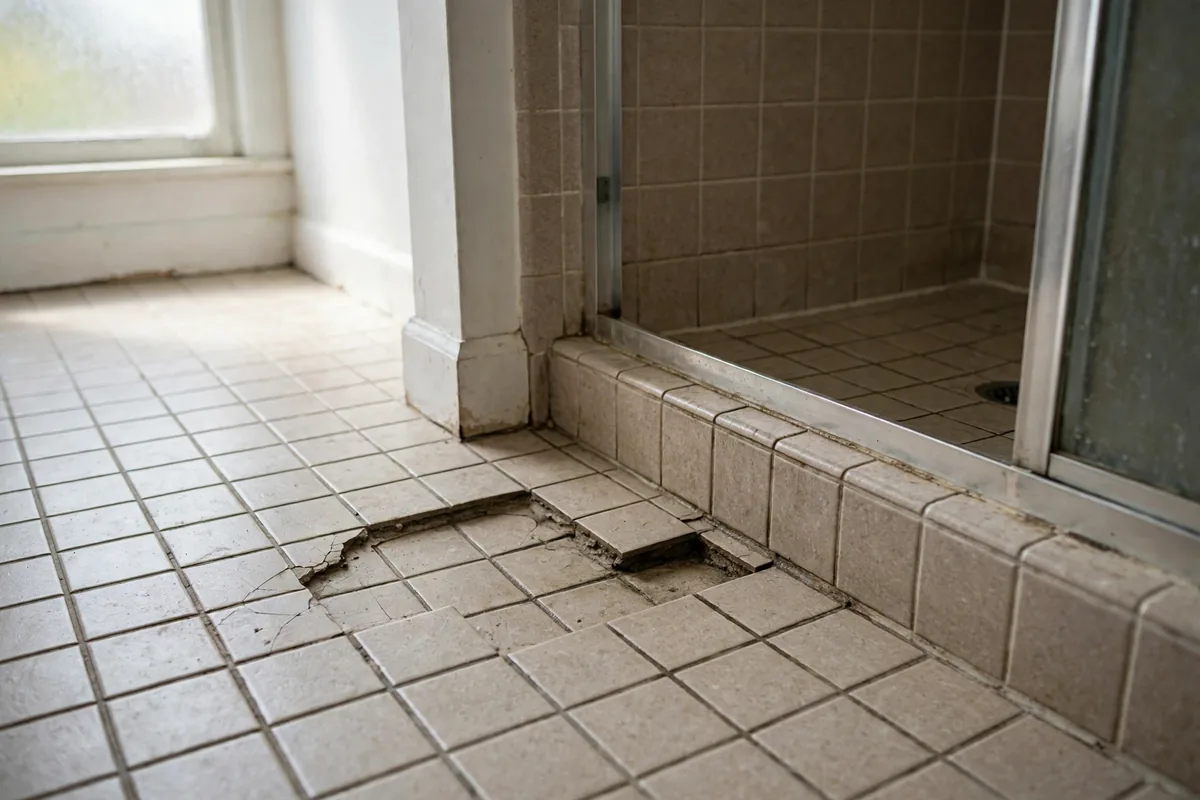
The clearest shower pan leak signs are a floor that feels soft or spongy near the shower, tiles that have loosened or cracked, and a musty smell in the bathroom that cleaning never removes. Work through this list in your own bathroom:
- Soft or springy floor just outside the shower door or beside the tub — the subfloor, the structural layer under your finished flooring, is getting wet and weakening.
- Loose, hollow-sounding or cracked tiles on the shower floor or the curb, and grout lines that stay dark and damp long after the shower is off.
- A musty odor that keeps coming back — a sign of mold growth, colonies of mold feeding on damp building materials behind the tile.
- Peeling paint, bubbling or a soft baseboard on the wall next to the shower — the baseboard is the trim at the bottom of the wall, and it swells when the drywall behind it wicks up water. Drywall is the gypsum wall board used on interior walls.
- A stain on the ceiling of the room below, or dampness in the wall cavity, the hollow space inside a framed wall, on the other side of the bathroom.
One sign on its own does not prove the pan is the problem — a toilet seal or a supply line can cause similar damage. The pattern of several signs together, worst right after showering, is what points at the pan.
Why A Shower Pan Leak Can Hide For Months
A shower pan leak hides because the water escapes below the tile, spreads along the top of the slab or soaks into the floor structure beneath, and never pools anywhere you can see it. Each shower adds a small amount — not enough to drip through a ceiling right away, but enough to keep the structure permanently damp.
Florida conditions make the hiding worse. Insulation, the material inside walls and under floors that slows heat flow, holds moisture against wood and wall framing once it gets wet. Warm indoor air and high humidity mean the hidden space rarely dries between showers. Over months, that constant damp is what turns a small liner crack into wood rot, the fungal decay that softens and weakens wet wood, in the floor framing. By the time the floor feels soft, the leak has usually been active for a long time.
How A Pro Confirms A Shower Pan Leak
Only a pro testing the shower itself can confirm a failing pan — the signs point to it, but signs alone are not a diagnosis. A pro starts with a moisture meter, a handheld tool that measures how much water is inside a material, taking readings across the bathroom floor and the walls nearby to map where the moisture is and where it stops. A pinless moisture meter, a flat sensor version that scans without leaving holes, lets the pro survey tile and drywall quickly.
Moisture mapping, the process of charting those readings room by room, shows whether the wet pattern centers on the shower — the pan's fingerprint — or starts somewhere else. A thermal imaging camera, a camera that shows surface temperatures as colors, can help trace cooler, damp areas behind tile. The confirming test is a flood test: the drain is plugged and the pan is filled with water, then the pro watches whether the level drops and checks below and around for new moisture. That test separates a pan failure from a drain or supply-line leak with certainty.
What Happens If You Leave It Leaking
Left alone, a pan leak keeps feeding water into the floor structure, and the repair grows from a shower rebuild into floor, wall and mold work. The subfloor weakens until tiles crack and the floor can feel unstable. Mold growth spreads through the damp wall cavity and into nearby insulation, and the musty smell moves from the bathroom into adjoining rooms.
The damage does not stay in the bathroom. Water wicks sideways into the vanity cabinetry, the built-in bathroom cabinets whose bases soak up water and swell, and under flooring in the next room — carpet pad, the foam layer under carpet that holds water like a sponge, in a bedroom, or the edge of hardwood flooring in a hallway. After a leak is fixed, a pro may apply an antimicrobial treatment, a cleaning product that slows mold and bacteria on cleaned surfaces, and check the room's humidity with a hygrometer, a small instrument that measures moisture in the air, before the shower is rebuilt. Catching the leak at the first signs keeps all of that smaller.
When To Call A Pro About A Shower Leak
Call a pro when the floor near the shower feels soft, when tiles loosen, when a musty smell will not leave the bathroom, or when a ceiling stain appears below a bathroom. Those are the patterns that mean water is already inside the structure, and the scope can only be judged with testing.
This site is a free referral service, not the contractor. One free call connects you with an independent local water damage pro who can typically arrive in 30–60 minutes, run the moisture checks and a flood test, and tell you plainly whether the pan is failing and what repair it needs. The pro sets the price for any work, and you decide whether to go ahead. Finding out early — before the subfloor and walls are involved — is what keeps a shower pan problem a bathroom project instead of a whole-floor one.
Not Sure How Bad It Is?
One free call connects you with a local pro who can check it in person — typically within 30–60 minutes.
Related Guides
Do You Need Mold Testing After Water Damage?
Guide — do you need mold testing after water damage
What Is Containment In Water Damage Restoration?
Guide — containment in water damage restoration
Reviewed By Hamza
Role: CEO
Hamza is the CEO of this business. He is very expert in local business and has great experience.
Updated October 23, 2026
Sources
Water In Your Home Right Now?
One free call connects you with an independent local pro who can typically arrive in 30–60 minutes.
Free Call · Answered 24/7 · Local Pros Near You