
Reviewed By Hamza · CEO · Updated October 23, 2026
How To Get Rid Of The Musty Smell After Water Damage
The water is gone, the floors look dry — but the house still smells musty. That smell is information: it means moisture is still trapped somewhere and mold is growing on it. To truly get rid of the musty smell after water damage, you have to find the hidden wet material, dry it or remove it, and clean what remains. Air fresheners only cover the signal. This guide walks through where the smell hides, how pros track it down with instruments instead of guesswork, the steps that actually remove it, the shortcuts that do not work, and when a lingering odor means you need professional help.
In This Guide
The Short Answer: A Musty Smell Means Something Is Still Wet
A musty smell after water damage almost always means hidden moisture is feeding mold growth — colonies of mold on wet building materials. The smell is produced by growing mold, so it does not fade for good until the wet material is dried or removed and the mold is cleaned up.
The U.S. EPA, the Environmental Protection Agency, gives the same advice in its mold guidance: fix the moisture problem first, because mold will keep returning to any surface that stays damp. In Florida's humidity, materials that look dry on the surface — a wall, a floor, a closet carpet — can stay wet inside for weeks. Treat the odor as a moisture alarm, not a cleaning problem, and it becomes a useful guide instead of a nuisance.
Where Does The Musty Smell Hide?
The smell hides where water went and air does not: inside walls, under flooring, and inside the AC system. The most common hiding places in Florida homes are a short list, and checking them in order finds most problems.
- The wall cavity — the hollow space inside a framed wall. Water from a leak or flood soaks the insulation and the back of the drywall, and the closed wall dries very slowly.
- Carpet pad — the soft foam layer under carpet. It holds water like a sponge, smells strongly when mold grows in it, and often has to be removed even when the carpet above it looks fine.
- Under laminate flooring — the layered floor with a fiberboard core. Water spreads between the floor and the slab and feeds mold where no one can see it.
- The AC system. An AC condensate overflow, when the air conditioner's drain line clogs and the pan spills, wets the area around the air handler, the indoor part of the AC system that moves air — and then the system blows the musty smell through the whole house.
- A crawlspace — the shallow space under a raised floor in older homes — where flood water can sit and soak floor joists from below.
A slab leak, a leak in a pipe under the concrete slab, deserves a mention too: it can keep one area of floor damp for months and produce a smell with no visible water anywhere.
How Do Pros Find Moisture You Cannot See?
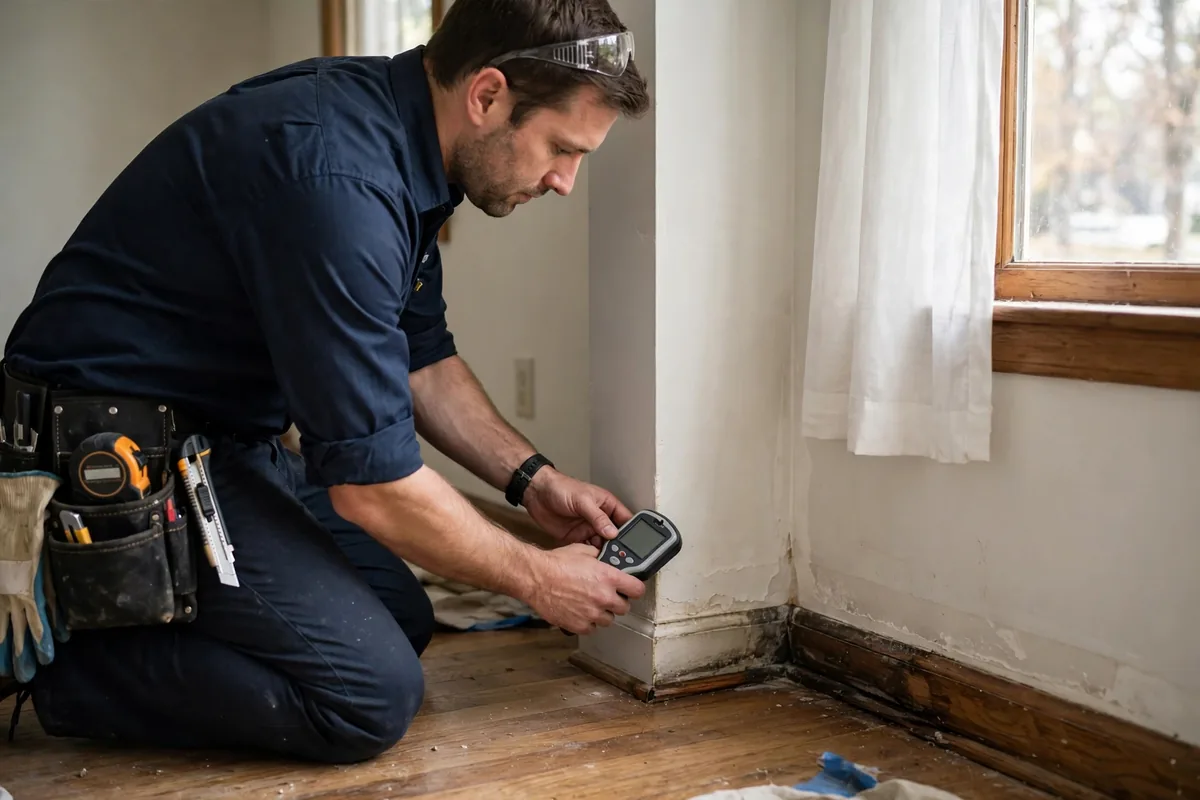
Pros find hidden moisture with instruments, not noses. A moisture meter, a handheld tool that measures how much water is inside wood, wall board, and other materials, confirms whether a suspect wall or floor is actually wet and how wet it is.
A pinless moisture meter, which scans below a surface without making holes, sweeps large areas fast — along baseboards, across floors, around tubs and AC closets. A thermal imaging camera, which shows temperature differences on a screen, makes damp areas show up as cooler patches, tracing a leak's path behind a wall without opening it. A hygrometer, which measures the humidity and temperature of the air, tells whether the room air itself is staying humid enough to keep materials damp. Together these tools turn "it smells somewhere in this room" into a map: this wall section is wet, that floor is dry, the source is the condensate line. That map is what makes the fix targeted instead of tearing out half the house.
How Do You Actually Get Rid Of The Musty Smell?
The smell goes away when three things happen in order: the water source is fixed, wet materials are dried or removed, and moldy surfaces are cleaned. Skip any step and the odor comes back, because the mold causing it is still there and still fed.
- Stop the source. A leaking pipe, a clogged condensate drain, or seepage has to be fixed first — drying a wall that is still being wet is pointless.
- Dry what can be saved. Structural drying, the planned drying of the building's materials with air movement and dehumidification, is checked with daily moisture readings until targets are met.
- Remove what cannot. Moldy carpet pad, soaked insulation — the material inside walls that holds moisture — and swollen baseboard, the trim strip where wall meets floor, usually come out; they cannot be cleaned reliably in place.
- Clean and treat what remains. Hard surfaces are cleaned, and an antimicrobial treatment, a cleaning product applied to surfaces to slow mold and bacteria growth, is used where the pro judges it appropriate. On larger jobs a HEPA air scrubber, a machine that pulls air through a high-efficiency filter, captures spores released during the work.
What Does Not Work: Covering The Smell Up
Covering the smell does not work, because it does nothing to the moisture or the mold. Scented sprays, plug-in fresheners, and odor-absorbing powders mask the signal for a few days while the colony behind the wall keeps growing.
Painting over a stained, musty wall is the most expensive version of the same mistake: the paint seals the odor in briefly, then the damp drywall — the gypsum wall board that swells when wet — blisters the new paint as moisture pushes through. Bleach on porous materials is another common dead end, because it does not reach mold growing inside the material and adds more water to it. Even a burst pipe, a pressurized pipe that split and flooded a room months ago, can be the hidden source behind a smell that "came out of nowhere" — the room was dried at the surface, but the inside of the wall never was. If the smell survives a round of surface cleaning, the problem is inside a material, and it needs measurement, not more fragrance.
When Does A Musty Smell Mean You Need A Pro?
Call a pro when the smell is strong or spreading, when you cannot find the source, when it appeared after a flood or a known leak, or when it returns after cleaning. Those patterns mean moisture is hidden inside the building, where household tools cannot measure it.
A pro's visit is mostly measurement: readings that prove which materials are wet, where the water is coming from, and whether drying or removal is the right fix. This site is a free referral service, not the contractor: one free call connects you with an independent local pro who can typically arrive in 30–60 minutes to find the source. The sooner hidden moisture is measured, the smaller the area that has to come out — a wall dried in the first days is a drying job, while the same wall found months later can be a mold job with drywall removal.
Not Sure How Bad It Is?
One free call connects you with a local pro who can check it in person — typically within 30–60 minutes.
Related Guides
Do You Need Mold Testing After Water Damage?
Guide — do you need mold testing after water damage
What Is Containment In Water Damage Restoration?
Guide — containment in water damage restoration
Reviewed By Hamza
Role: CEO
Hamza is the CEO of this business. He is very expert in local business and has great experience.
Updated October 23, 2026
Sources
Water In Your Home Right Now?
One free call connects you with an independent local pro who can typically arrive in 30–60 minutes.
Free Call · Answered 24/7 · Local Pros Near You